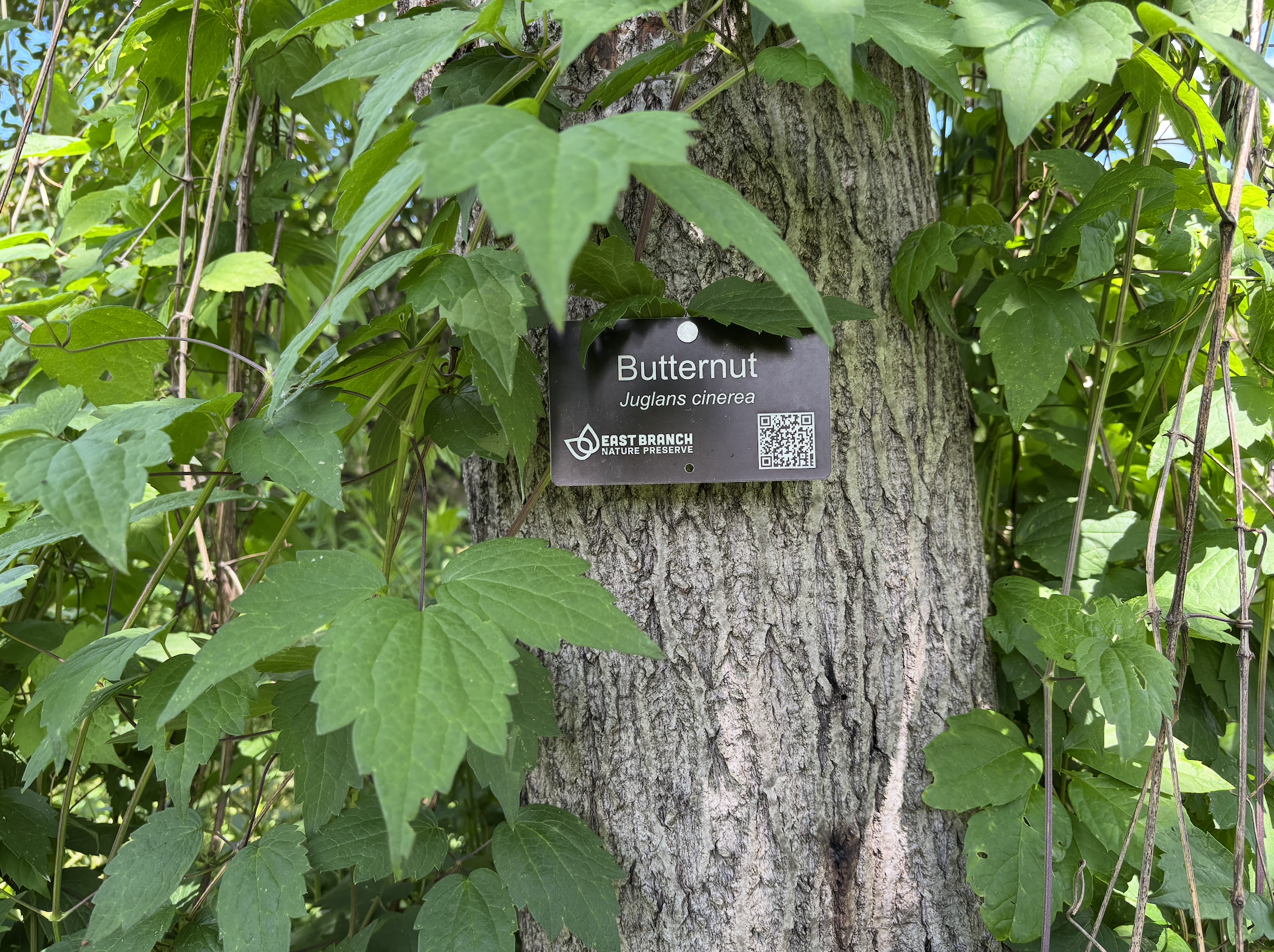
I have stepped down from the board of the Catskills Water Discovery Center, but remain a volunteer at the East Branch Nature Preserve. Every week, I will spend time on the trail, doing nature reports and a bit of train spotting. The Delaware & Ulster Railroad will be running its historic tourist train throughout July and August and the train passes across the trailhead. It’s a magical place to be, watching the train trundle down the tracks, underneath a soft, breezy tree canopy, being waved at by tourists as they float by.
So now I’m free to continue Wild Walk & Watercolor in other locations across the Catskills. The next session will be on July 18th, 2026 1pm – 5pm at Lazy Crazy Acres Farm. Please click here to pay for your spot. Click here for the Wild Walk & Watercolor Page.
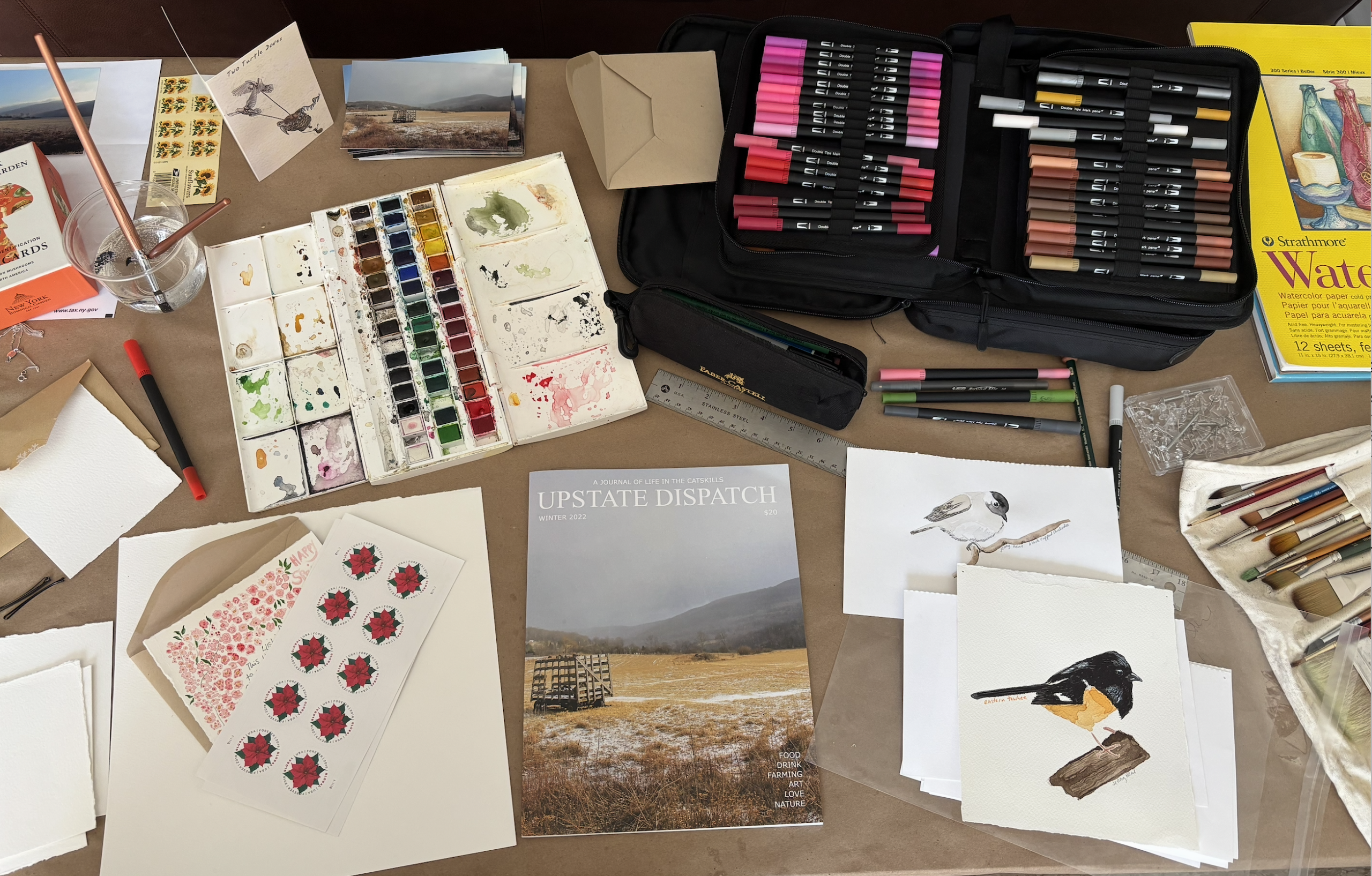
The AMR Open Studios Tour will take place from Friday July 24th to Sunday 26th, 2026. You can pick up a map from most retailers and restaurants in the Catskills. My studio will be open from 11am – 6pm on all three days.
I continue my biography of Alfie, my dog on Substack here.
My studio will be open Friday 11 – 4, Saturday 11 – 5, Sunday 11 – 4 every weekend throughout the Catskills.
818 Main Street, Margaretville, NY 12455. I hope to see you there soon!
Latest News: I will be leading an art retreat at Jessica Vecchione’s villa in Umbria in Italy in September. Read all about the event here. Find the Facebook link here and join next week’s Zoom call to find out more and discuss the details!
Spring was a blur! Board membership duties, a lot of admin/business work and some legal issues kept me very busy, but I had three sales in May, including the Catskills Mandala, so I will be working on more mandalas in coming weeks.
The Gallery & Studio will remain open until the end of August.
Upstate Dispatch Gallery & Studio, 818 Main Street, Margaretville, NY 12455.
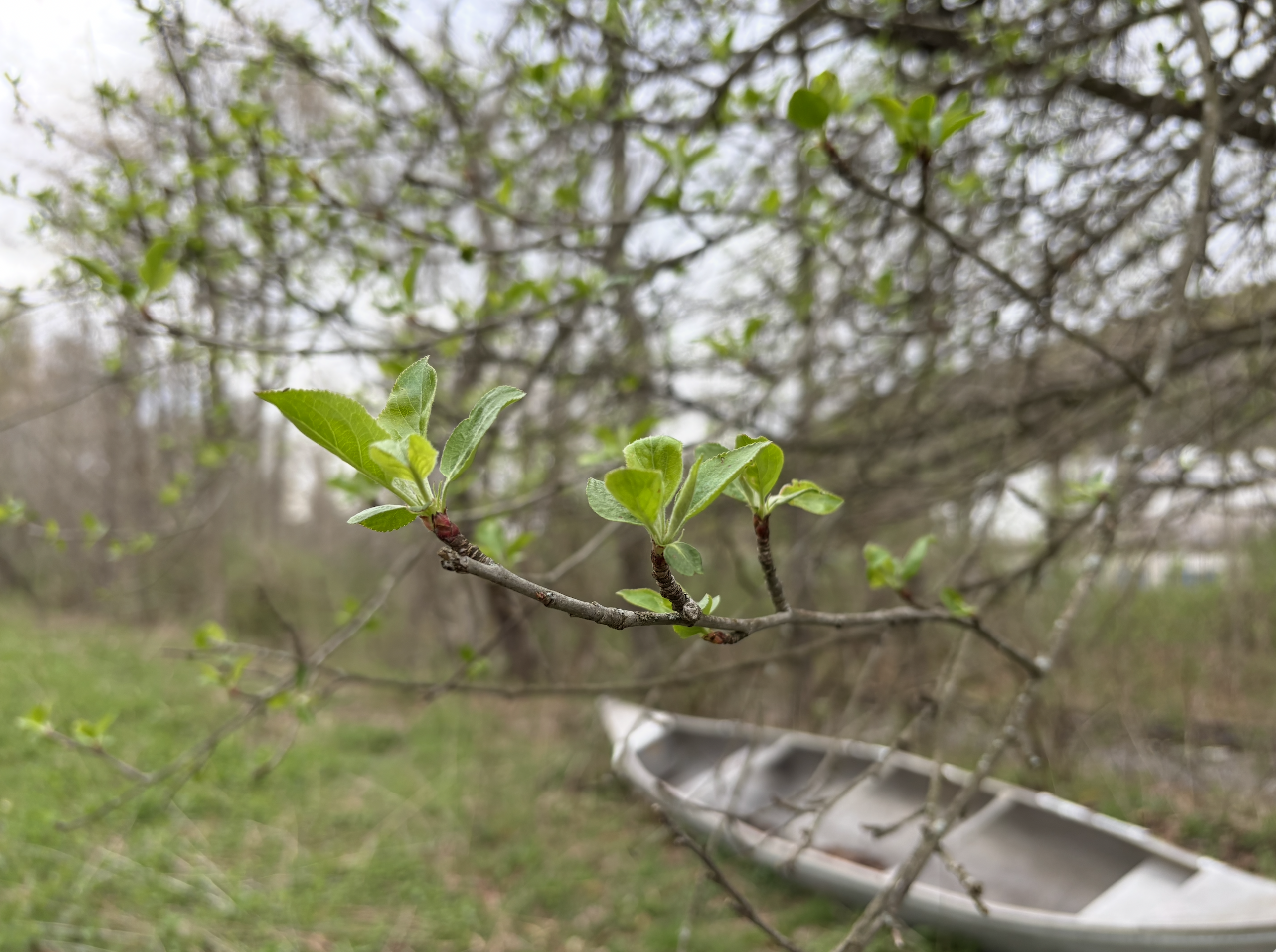
It’s been a joy to spend the first month of spring inspecting the trail at the East Branch Nature Preserve at the Catskills Water Discovery Center, a local Catskills conversation non-profit where I have been a board member and secretary since last fall. Last October, a fellow board member and I walked with Laura Silverman of the Outside Institute, and we identified many plant and tree species on our trail. We developed a list of everything that we found on the trail and spent spring watching all of it slowly wake from its slumber.
This week, we walked with the Catskills Forest Association to identify our tree species and prepare for a Tree Identification event that will be open to the public this year.
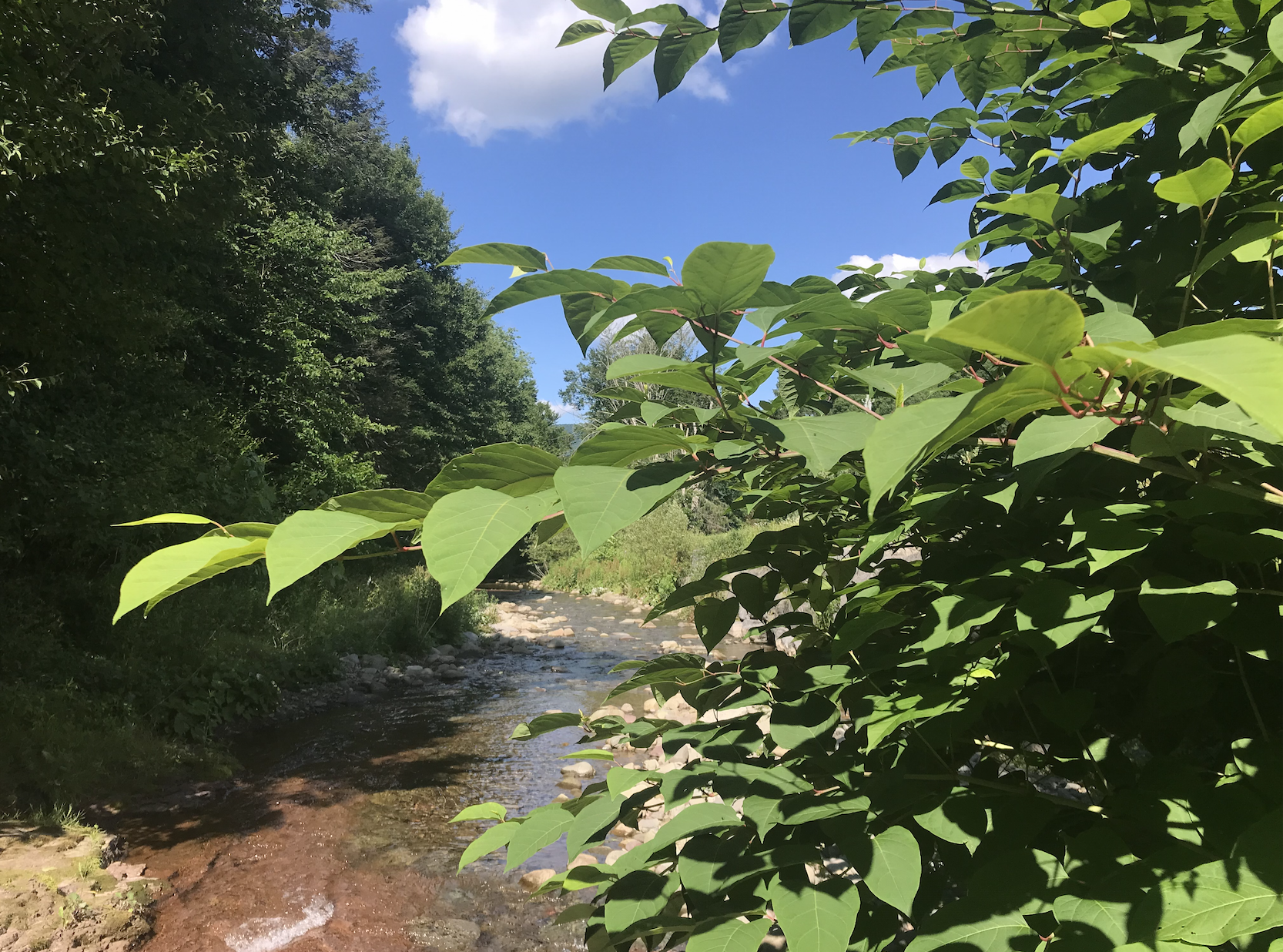
When I first began to explore Jake’s farm, Lazy Crazy Acres, in that winter of 2020, I noticed what looked like old, dead bamboo by the river – very tall beige rods with those distinctive horizontal ridges – but it was actually Japanese Knotweed, a member of the buckwheat family. This imported Japanese ornamental is everywhere and is as exceptionally difficult to eradicate as any living pest like the emerald ash borer or hemlock wooly adelgid. It’s a problem because it’s so incredibly voracious, growing by feet in a day, and its roots can destroy the foundation of a house. The stems can grow up to 15ft tall, and they block natural light for any other plant beneath it. The plant quickly takes over large areas and smothers everything on the forest floor below and disrupts wildlife habitats. It has beautiful large spade-shaped leaves with their deep blood-red stems, all shooting from hollow green bamboo-like rods.
The year 1992 was dubbed by The Queen of England to be her Annus Horribilis – a common Latin term for horrible year – after parts of Windsor castle burned down along with some of its priceless historical artifacts.
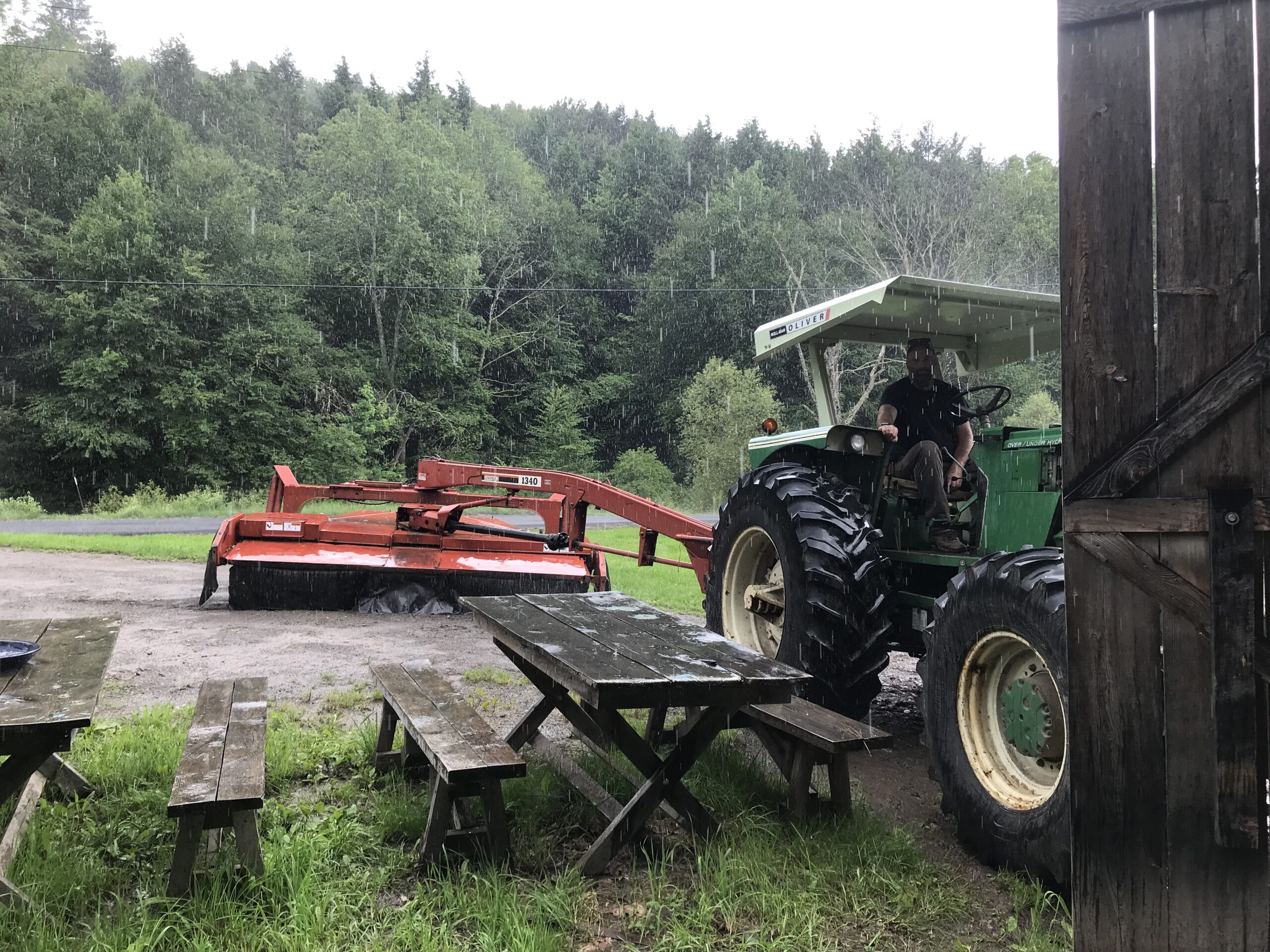
This year is farmer Jake Fairbairn’s Annus Hay-ribilis, an extraordinarily bad hay season, the worst in his entire decades-long career on the farm, due to this summer’s incessant rain. Nobody’s going to get that reference, Jake told me, but I just couldn’t think of another hay pun.
I didn’t think the reference was that well-known until along came The Crown on Netflix, which I stopped watching after Season 2. Being a Londoner, I had watched the real thing play out in British newspapers growing up and that was enough for me. No Brit who was old enough in 1992 can forget the images of the sour-faced Queen picking through the castle wreckage in her Welly boots and headscarf, tutting over charred objects that had been once admired by the likes of Henry VIII.
I’ve been asked to put my smoothie and tonic recipes on the website. Along with my curry sauce, this food has stopped me from getting sick these past few years.
Apples and blueberries grow really well in the Catskills region and there are plenty of U-pick places, like Blue Sky Farm & Winery in Stamford, who have 5 acres of blueberries. You can pick as many as you’d like and freeze them for the winter. I picked 20lbs of blueberries this summer and I have almost finished them. I put them in a smoothie – straight out of the freezer – that I eat every day.
I also make a high-calorie smoothie for the maple tapper in my life. Jake – who is 6 ft 6 – has to hike all over the mountains working in the forest, fixing lines and tapping trees in freezing cold weather. This smoothie gives him energy and stops him from getting sick. It’s made in a Nutribullet.
The curry sauce recipe that I developed over the winter has also helped keep illness at bay, but you will find this in the winter issue of the print version of Upstate Dispatch, sold at Roxbury General, Diamond Hollow Books and Tree Juice Maple Syrup.
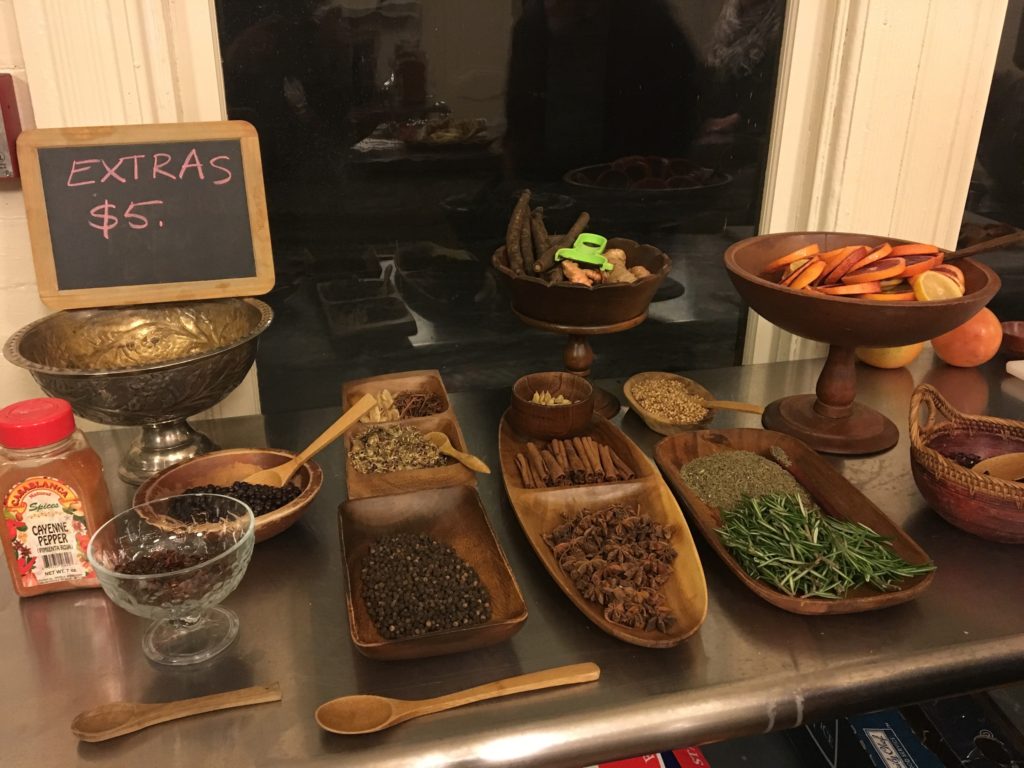
I developed a curry sauce made from scratch during the pandemic. Curry is part of Ayurvedic diet in which you eat foods that protect your health, so this year I tried to grow some of the ingredients. There are plenty of foods in this diet that don’t grow well in this climate, but we do have some good replacements. For example, spice bush, native to the Catskills and Northeast America, is a good stand-in for spices because you can eat the leaves, twigs and berries. I’ve never found spice bush when foraging here, but I did buy a few seedlings from Barkaboom Native Plants based here in the Catskills.
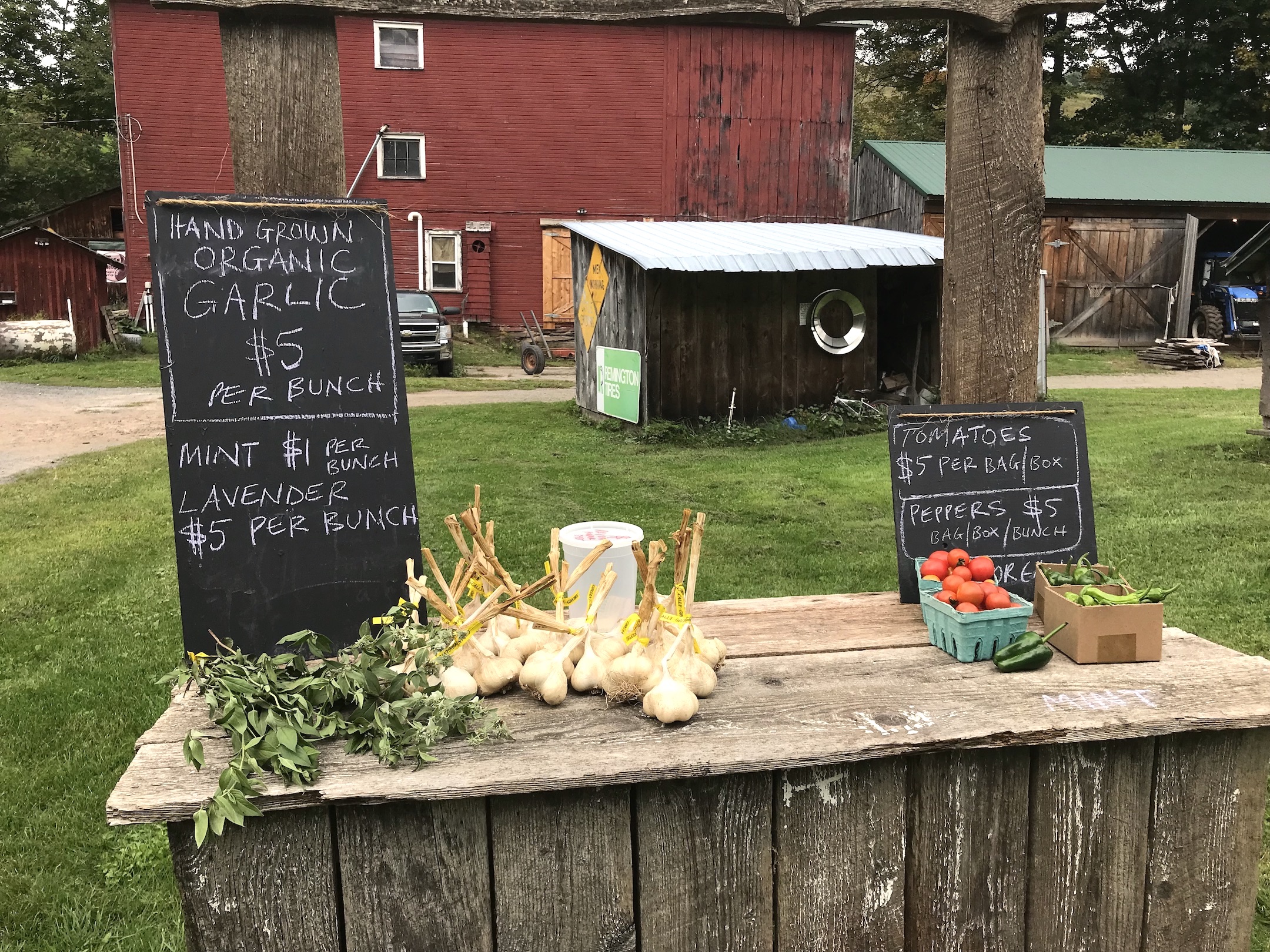
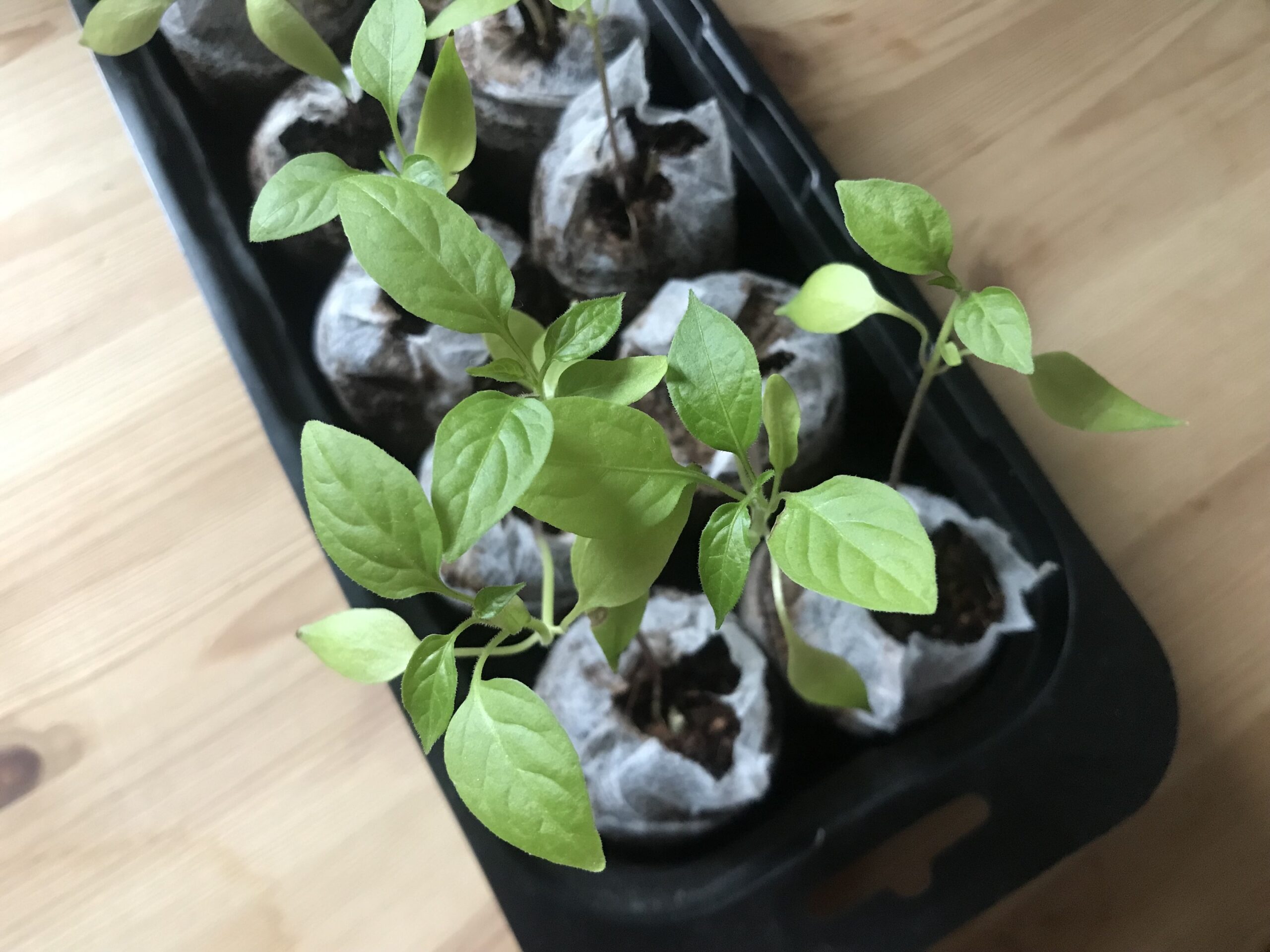
Some of what I planted at Lazy Crazy Acres farm did not do well, or even grow at all, but what did grow really well were arugula, red bliss potatoes, garlic, tomatoes, and hot peppers. We have shishito, jalapeno, cayenne, anaheim and exactly one dark green poblano. We got at least 30 shishito peppers from one plant alone, although we had to get it under cover because the deer started to eat the plant. I also planted mint and lavender as companion plants. The mint has kept the tomatoes pest-free except for one lonely, recent hornworm. All these are on the farm stand, except the hornworm who was invited to move across the street. Considering that we’re on dead-end road, this little fledgling farm stand is not doing too badly. Visitors to Tree Juice Maple Syrup are the biggest customers, which is where the farm stand is, and some of the garlic will be going into the syrup.
Whatever does not get sold will get dried or preserved. We grew 300 heads of garlic and the cloves from the biggest bulbs will get planted in October.
The farm stand is open when it’s not raining. We’ve yet to add a roof, but we all have to start somewhere.
I’ve recently been receiving a lot of kind feedback on the writing I do here, and some inquiries into what I’ve been up to since I last posted back in June. It’s the feedback – along with the helpful donations – that keeps me going, so here’s an update. Daily Catskills will resume in the next few days, from the September equinox until Winter solstice and all the snowbirds will shortly be seeing our Fall in all its glory from afar. Stay tuned!
The Catskills’ Village of Fleischmanns, has another new restaurant, offering a wide range of delicious and authentic Greek takeout food: Aegean Flavor.
The advantage of opening in Fleischmanns is that there is still a dearth of variety in the Catskills and residents are excited to have novel options. The restaurant opened last week, was immediately successful and busy without any advertising, and the food is exceptional, and reasonably priced. They do the staple lamb and beef gyro in pita bread ($8.95) that is tender, not too oily and not too dry, just perfect. The pita in which most sandwiches come is plump and fresh. Spanakopita, a spinach and cheese turnover in filo pastry, ($4.50 pictured below) is light and tasty, not too salty. For vegetarians, the falafel sandwich ($8.95 pictured above) is superb, stuffed into the pita with crisp cucumber and healthy tomato, all dressed in a lightly spicy sauce. There is also a cheese turnover called tiropita for $4.50.
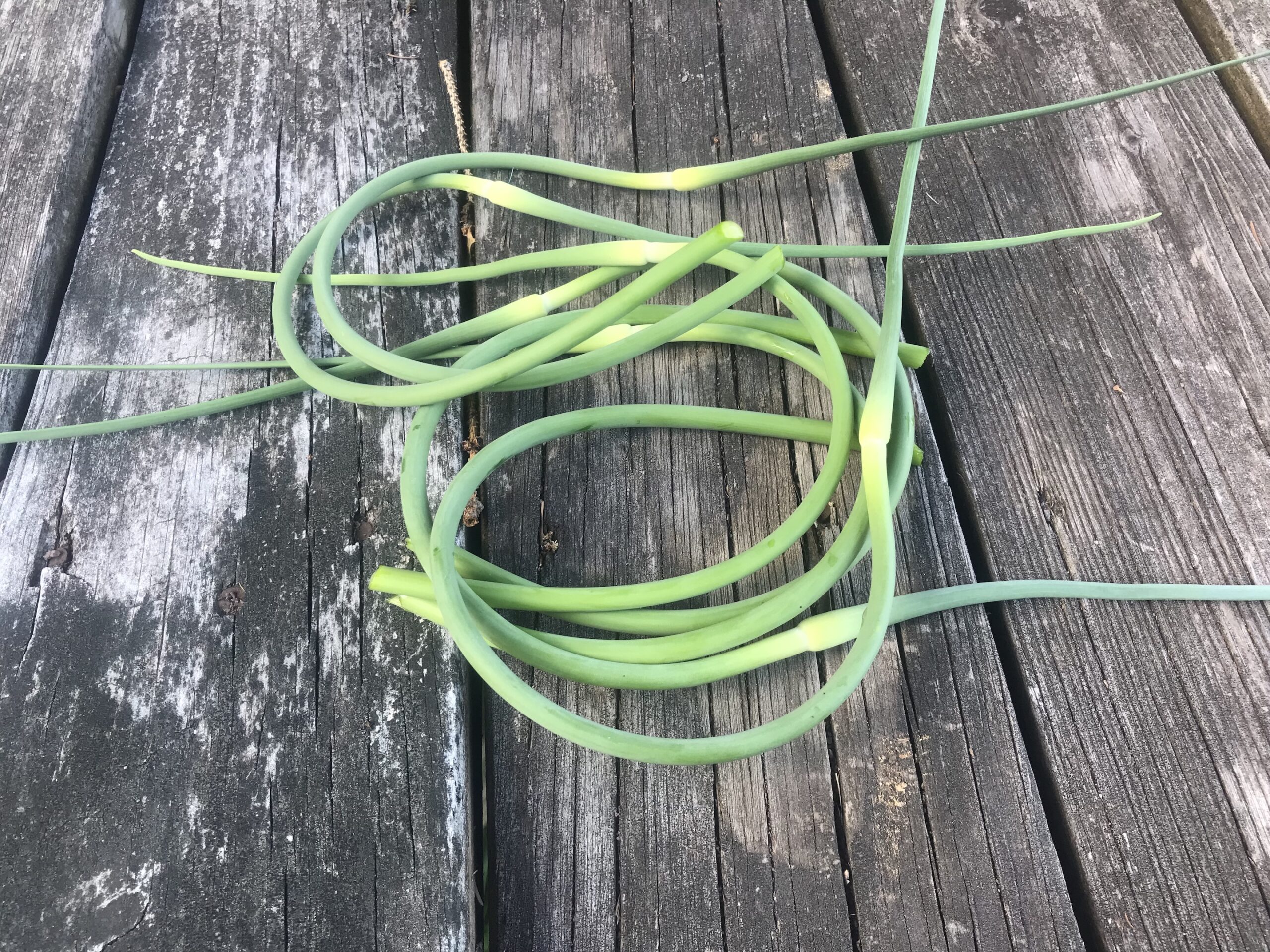
Most of the scapes on the garlic have been removed and I have about 70 or 80 to use or sell. The scape is the developing garlic flower – the fully-blooming flower is pictured bottom right – and it’s removed in order to allow the plant to direct its energy to the bulb.
Pictured bottom left is the scape growing on the garlic stalk viewed from above. See our Instagram story for a video that gives you a much clearer picture.
Scapes have a much more delicate, subtle sweetness than bulb garlic. They are delicious chopped and added to omelettes, scrambled eggs and stir-fry dishes like you would spring onions or shallots. They’re a lovely addition to creamy, roasted potatoes.
They also make a superb pesto. Eaten raw, garlic provides those infamous, extraordinary health benefits in addition to flaming hot breath.
Garlic Scape Pesto
10-12 large garlic scapes 1/4 cup of grated or shredded parmesan 1/4 cup of pine nuts or sunflower seeds 1/4 a cup of olive oil Salt and pepper to taste
Blend all the ingredients except for the oil in a blender. Mix in the oil when the other ingredients are blended well. If your pesto is too thick, add a drizzle of extra oil. Serve on bruschetta, toast points, crackers. Or add a dollop to soups, pasta and cheese plates. Delicious!
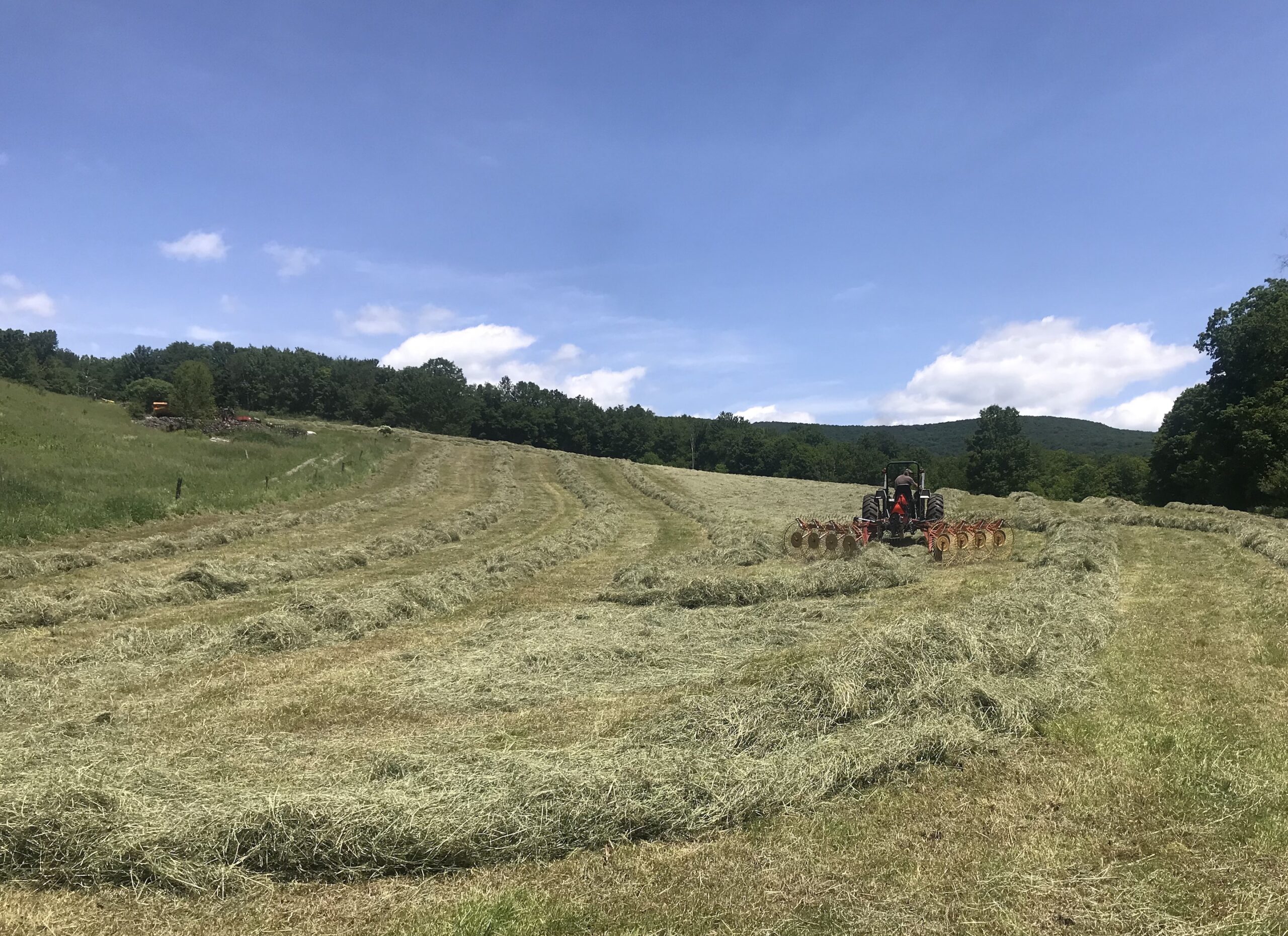
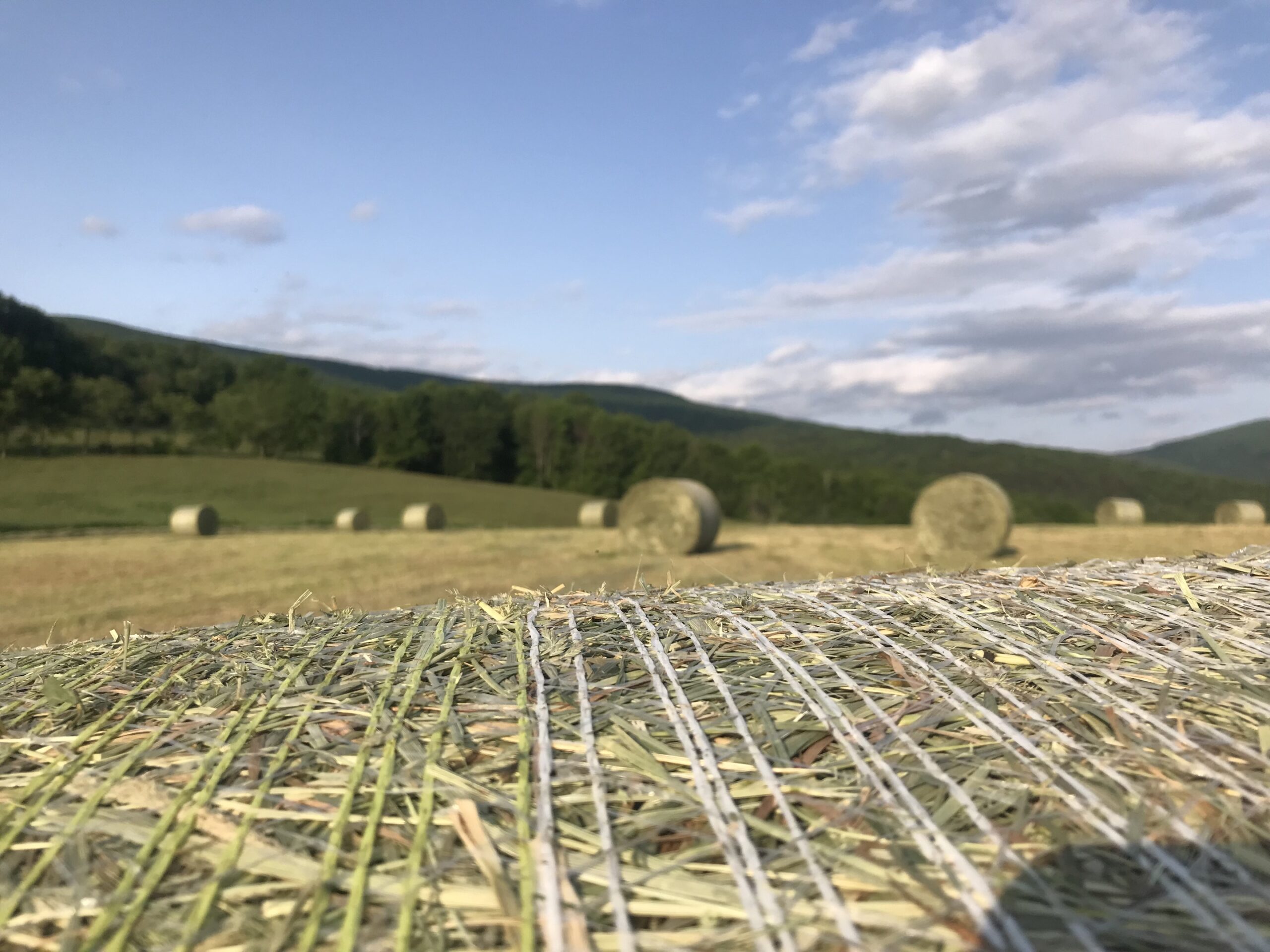
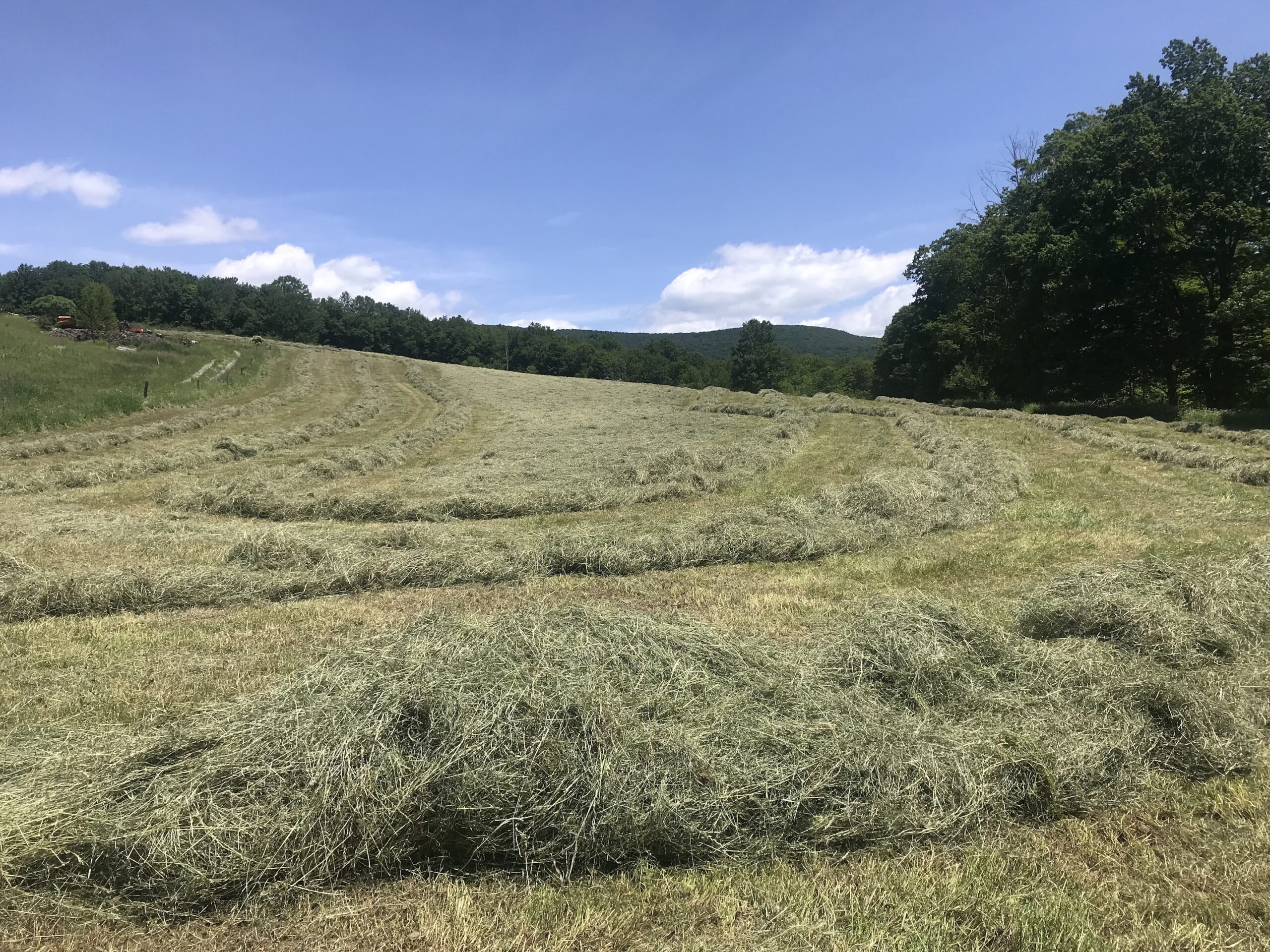
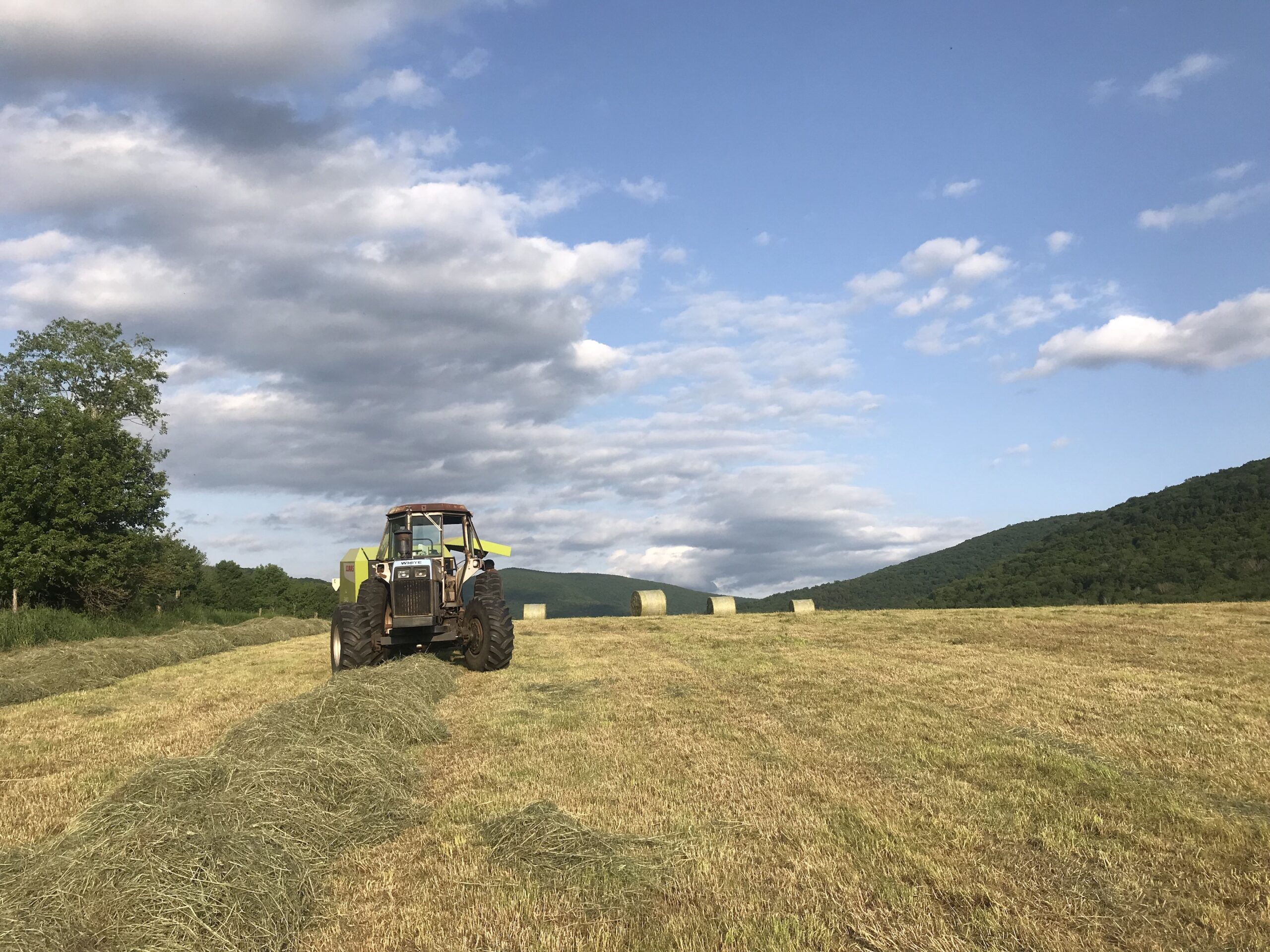
The rake (above) drags the freshly fluffed hay into windrows and then the baling machine is driven down those rows and presses the hay into a tight bale, while the clouds overhead look like they’re forming their own rows ready to rain on the hay. At least the rain waited until 3am, when all the hay had been baled, before it unleashed a clamoring thunderstorm, breaking the humidity and marking an end to a stressful three days.
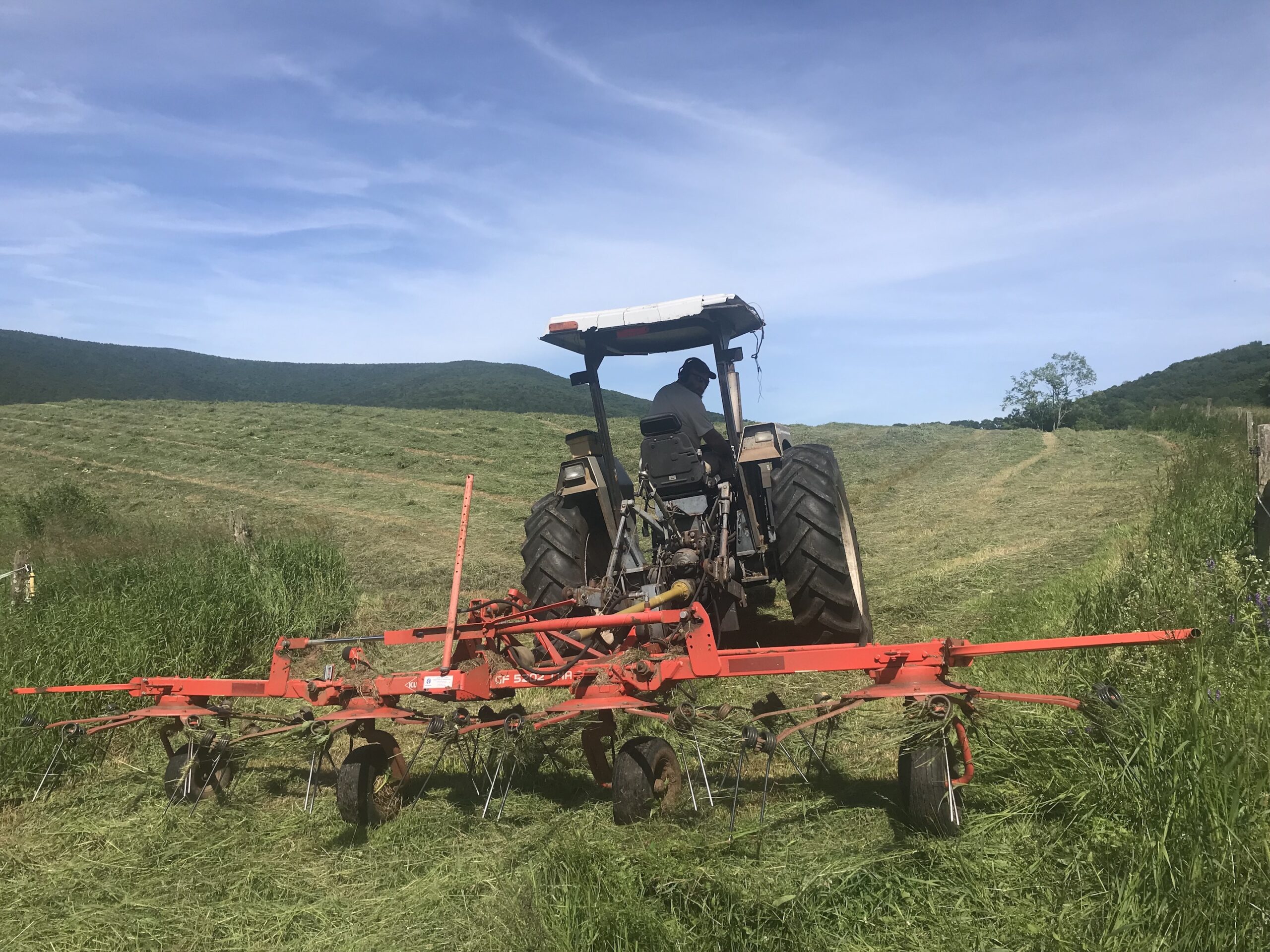
On Day 2 of haying, farmers fluff up the hay with a machine known as a “tedder”. Nobody knows why it’s called this. The tedder looks a little like a mower, but it has sets of long prongs mounted on revolving circular heads that twist the hay around and toss it like a giant salad. This helps it dry in the sun. Tedding takes place once in the morning and again, at least once, in the afternoon because the ground and the unmowed part of the hay is still damp.
Only ten acres were mowed because after the risk assessment of the weather, comes the hedging: if it rains, then only ten acres were lost.
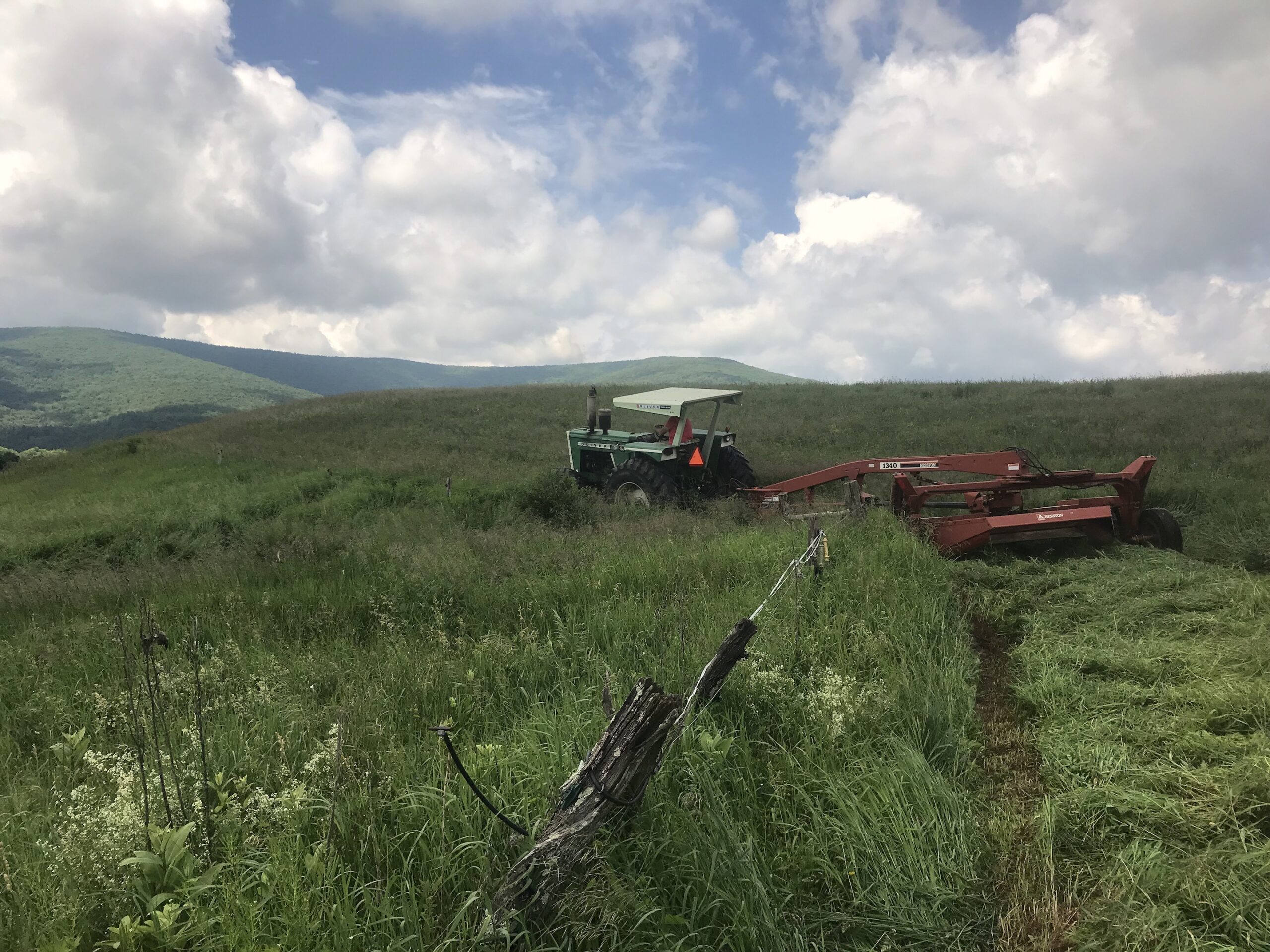
To be a farmer is to engage in continual risk assessment. To live on a farm is to accept a high level of risk, to be comfortable with being uncomfortable, watching the weather forecast like a skittish doe with her new fawn in Spring. Small-scale farming is dependent on something more unpredictable than the economy and that’s the weather. It’s the boss here and it’s flighty, but the farmer needs at least three days of sunshine to make hay and here on June 13th, was our first window of opportunity. After a rainy Sunday and a colder June than 2021, the forecast predicted a low chance of rain, and on Monday Jake mowed under ominous clouds, some of them as dark as slate and I held my breath as they sailed overhead.
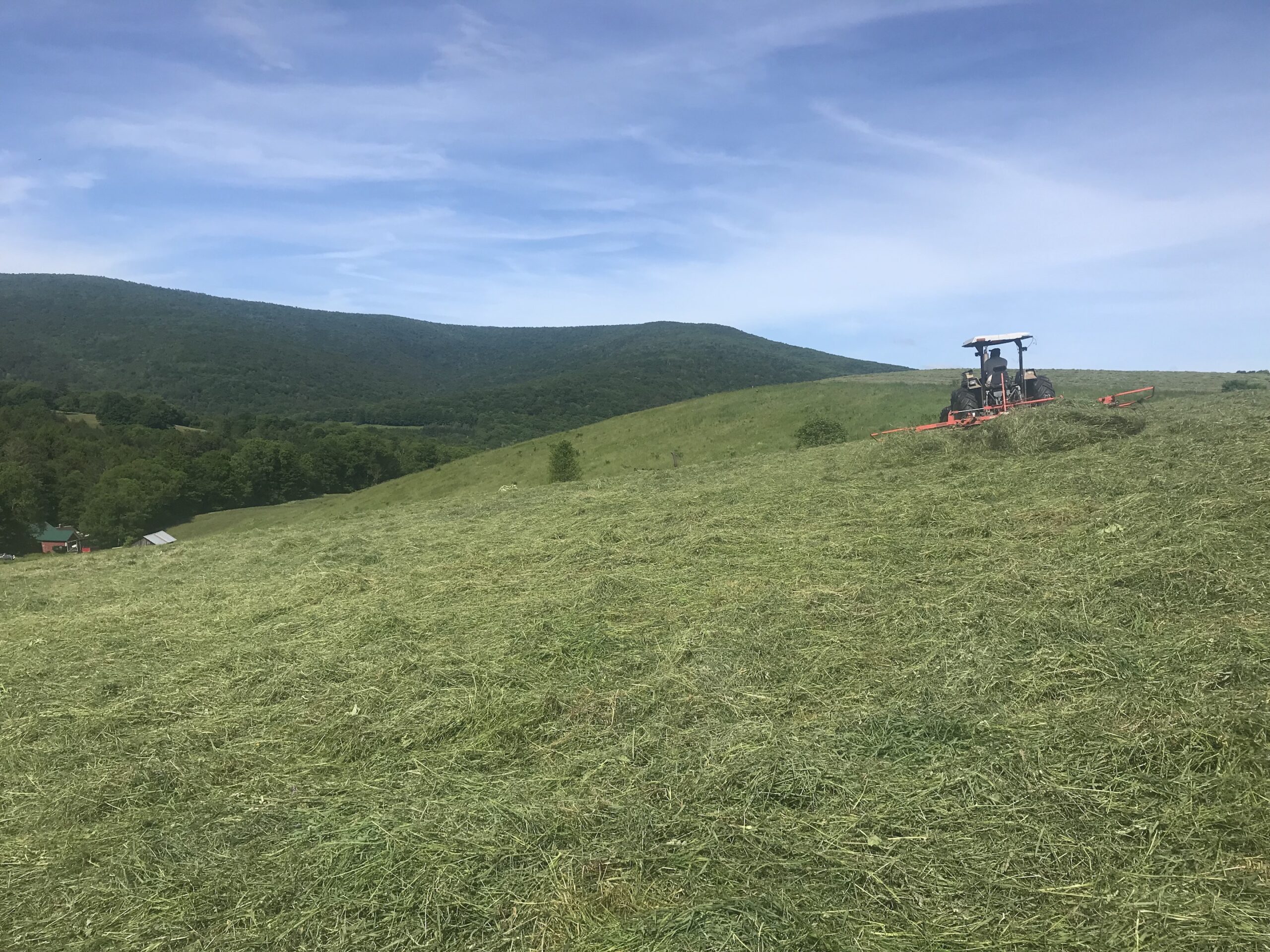
On Day 1 of haying at Lazy Crazy Acres, ten acres of lush, bushy, thickly fertile grasses were mowed.
If you’re going hiking any time soon eat this first. Arguably one of the most hearty and delicious breakfasts in the Catskills: one large runny egg over easy, smothered in Hollandaise sauce, over slices of pastrami, all on top of a large hash brown. A sensational Catskills breakfast.
Spring is here and the wild edibles are unfurling. This week, we have garlic mustard around the raised beds here at Lazy Crazy Acres, in their second year. Leaves, shoots, seeds and the unopened flowers of garlic mustard are edible at certain stages of growth, and if you don’t eat all of your crop it should be pulled because it’s an invasive weed that crowds out native plants.
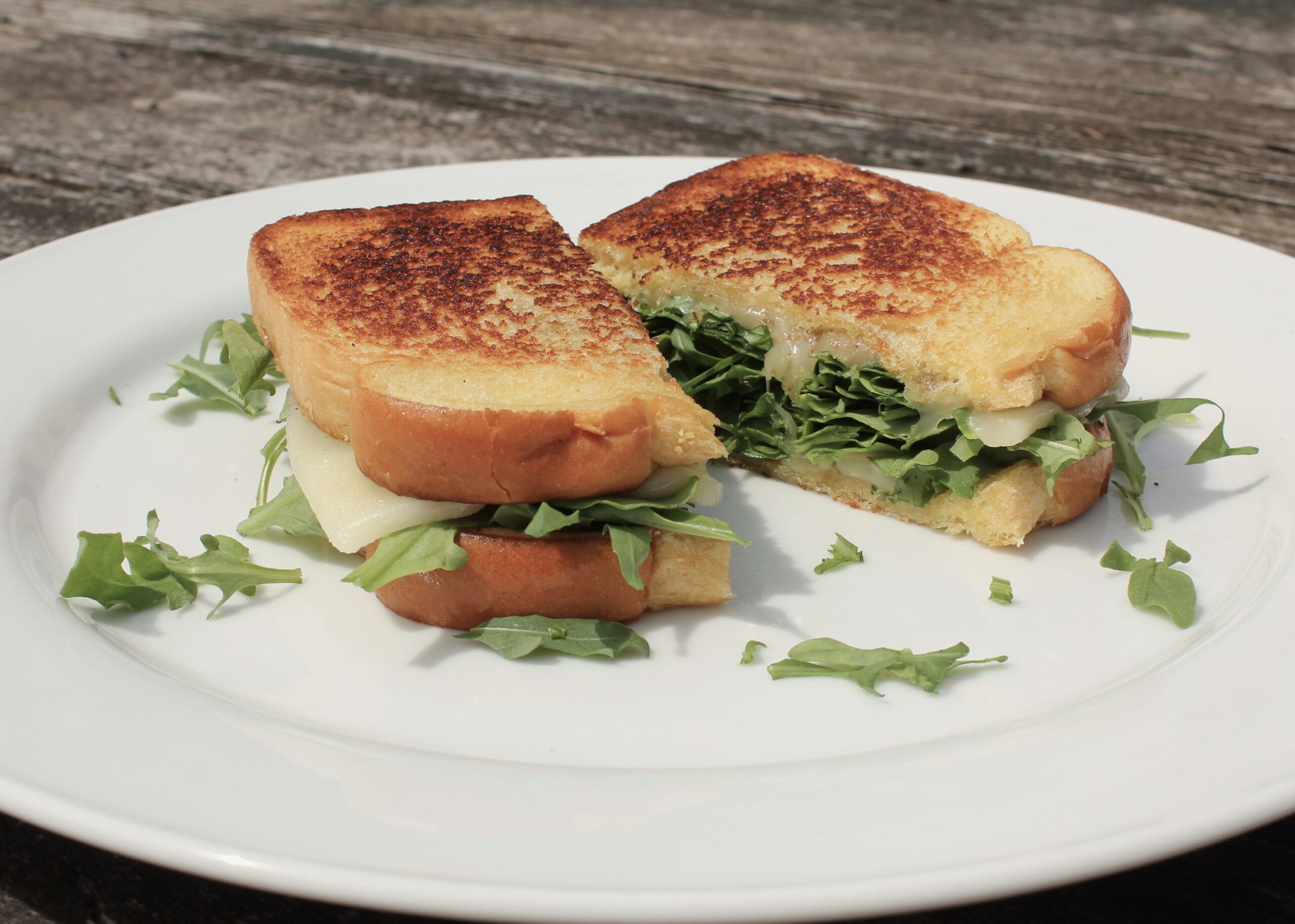
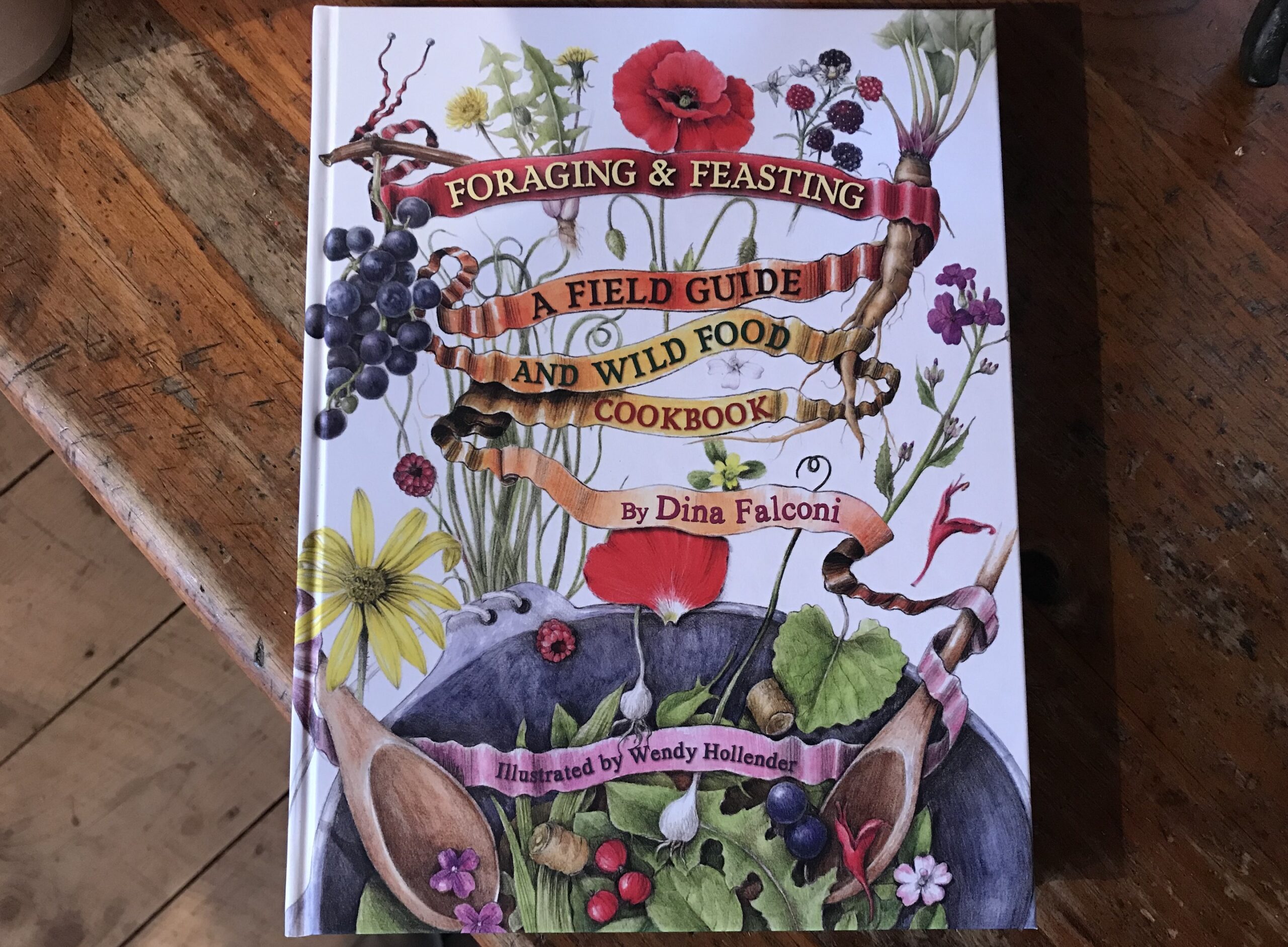
Greens like garlic mustard can be introduced into your spring diet by packing them into a grilled cheese. I got this idea from Dina Falconi’s Foraging & Feasting: A Field Guide and Wild Food Cookbook – a must-have in every wild kitchen. In it, she details her “Wild Grilled Cheese Master Recipe”, but there are a variety of ways to make the classic American grilled cheese. Every American has their own method as I discovered when I first arrived in the States. In England, we fry everything, even chocolate, so even I’m surprised that we didn’t come up with the idea of frying a cheese sandwich in a pan. I was taught to cook a grilled cheese by my own American and that recipe is below.
Image: Mountain Arts Media, courtesy of Bill Birns
Bills Birns needs no introduction having been a teacher in the Central Catskills area for over 40 years. Read my first interview with him here, the most popular post on the website with 13,000 views and counting on social media. He has very much made an impact.
As a writer and poet, Bill has published several works, his latest being Fleischmanns In Verse, A History and next Tuesday he will read from this works at The Village East Cafe in Fleischmanns, 1109 Main Street, Fleischmanns, NY 12430 on Tuesday April 12th, 2022 at 5.30pm.
If the last two years have taught us anything, it’s that good health is everything, and here on the farm I have been focusing (in between cocktails) on immune-boosting foods. I was raised in London and, growing up, ate a lot of curry. It was this dish that I continually cooked throughout this past winter – developing sauce recipes from scratch – that helped stop us from getting sick. My recipe will be in the upcoming print version of Upstate Dispatch. My people, whenever they felt a cold coming would cook up a strong curry: the hot peppers, coriander, ginger, cumin, garlic, onions, mushrooms, and turmeric, all of which I am now growing on the farm, so that we will have an endless supply this year. I’m calling it pandemic PTSD because I don’t usually do themes. Corny alliteration, yes, but not themes. Last fall, I planted 200 cloves of garlic and they are just now sprouting.
Ginger, a miracle root, grows wild in the Catskills, but I have never foraged it. Grated, raw ginger can also be soaked overnight in juice for a morning pick-me-up, and put into cocktails. You can harvest the root while it’s still growing in pots in your house. If you’re feeling run down, peel and chop one cup of ginger; boil it in a large saucepan full of water until the water goes brown; strain out the ginger and let the water cool to a drinkable temperature; drink the water. In previous years, I’ve bought ginger from Straight Out Of The Ground in Roxbury, and now there is a company here that cultivates the wild plants of the Catskills called Barkaboom Native Plants. You will also find them at the Pakatan Farmers’ Market that begins its season on May 14th, 2022.
Black cumin seed, like turmeric root, is used in Ayurvedic cooking and considered a medicinal herb, but this plant likes warm weather. It is grown in the Mediterranean and beyond. It may not make it here on the farm where winter is six months long, and if so, it will be going in pots on the radiator by a window along with the turmeric. Alan White of Two Stones Farm told me to plant whatever grows well on your land and swap with your neighbors, so we’ll also be planting roots, tubers and all manner of greens.
Growing mushrooms is more complicated. I will be inoculating a tree with mushroom plugs after the last frost. And once the ramps come up, I’ll be transplanting some of them in wetlands closer to the forest. More on that later.
This weekend Saturday and Sunday, March 26th and 27th will be the second and final “Maple Weekend” across New York State, sponsored by New York State Maple Producers’ Association. Sap houses across New York State will open their doors to visitors, who will be able to watch the sap boiling into sugar and learn about New York’s maple sugar making processes. Here in Rider Hollow we have Tree Juice Maple Syrup who will be participating from 10am to 4pm on both days (251 Rider Hollow Road, Arkville, NY). It’s up to the weather as to whether the sap will be flowing and boiling, but there will be syrup to taste and buy.
It’s been a learning process since Upstate Dispatch moved to Rider Hollow in July 2021 and I learnt how to tap maple trees in one of the worst winters ever (2020/2021): read my account here. Syrup production is such an involved process and reliant on the optimum temperatures.
More facts about maple syrup:
– no artificial colouring, flavouring, preservatives or additives – same calcium concentration as milk – contains folic acid, biotin and niacin, which convert proteins and sugars to energy – virtually sodium-free – encourages growth and production of red blood cells – has no fat and no proteins and is a good source of calcium, iron and thiamin
Many thanks to the owners of the Catskills cafes here in Delco that stayed open, even with limited hours or takeout service, during the rough times of this past year or so, when we needed them the most. Just to call them merely coffee shops would not have done these essential venues justice. Cafe life is a scene, with the kind of meeting places we know we can’t live without now, and it has taken nerves of steel for their owners just to have kept the lights on.
Cafes like Village East in Fleischmanns have fostered local community and been comfort in hard times. Places like the Stamford Coffee Shop have provided entertainment like game nights in addition to a solid, well-made latte.
Here are five of the best Catskills cafes noteworthy for coffee that packs a punch, dedicated service, excellent food or commitment to the community of our towns and villages of Delaware County.
The foliage is just starting to turn in this part of the Catskills: Dry Brook Valley. We have splotches of red, a dash of yellow, and the green is beginning to fade. Go to our Instagram page to watch the fall colors.
The I Love NY fall foliage map that details fall’s progress in New York State gets updated every Wednesday.
The Farmers Almanac explains autumn, the equinox, the foliage and more in this Fall article.
Saturday, September 25th is a Free #Fishing Day in New York, so residents and non-residents don’t need a fishing license to go fishing. Plan your fishing excursion here.
Fall activities at Belleare Mountain. Ride the scenic gondola until October 11th, 2021 or go hiking on one of the many trails over the mountain. Plus get your lift tickets and equipment in advance of 2021. 2021-22 winter season ski pass holders can ride the gondola for free anytime during normal operating hours, excluding special events.
Saturday 25th, September in Halcottsville, The Catskill Forest Association is hosting a Cider Making Demonstration.
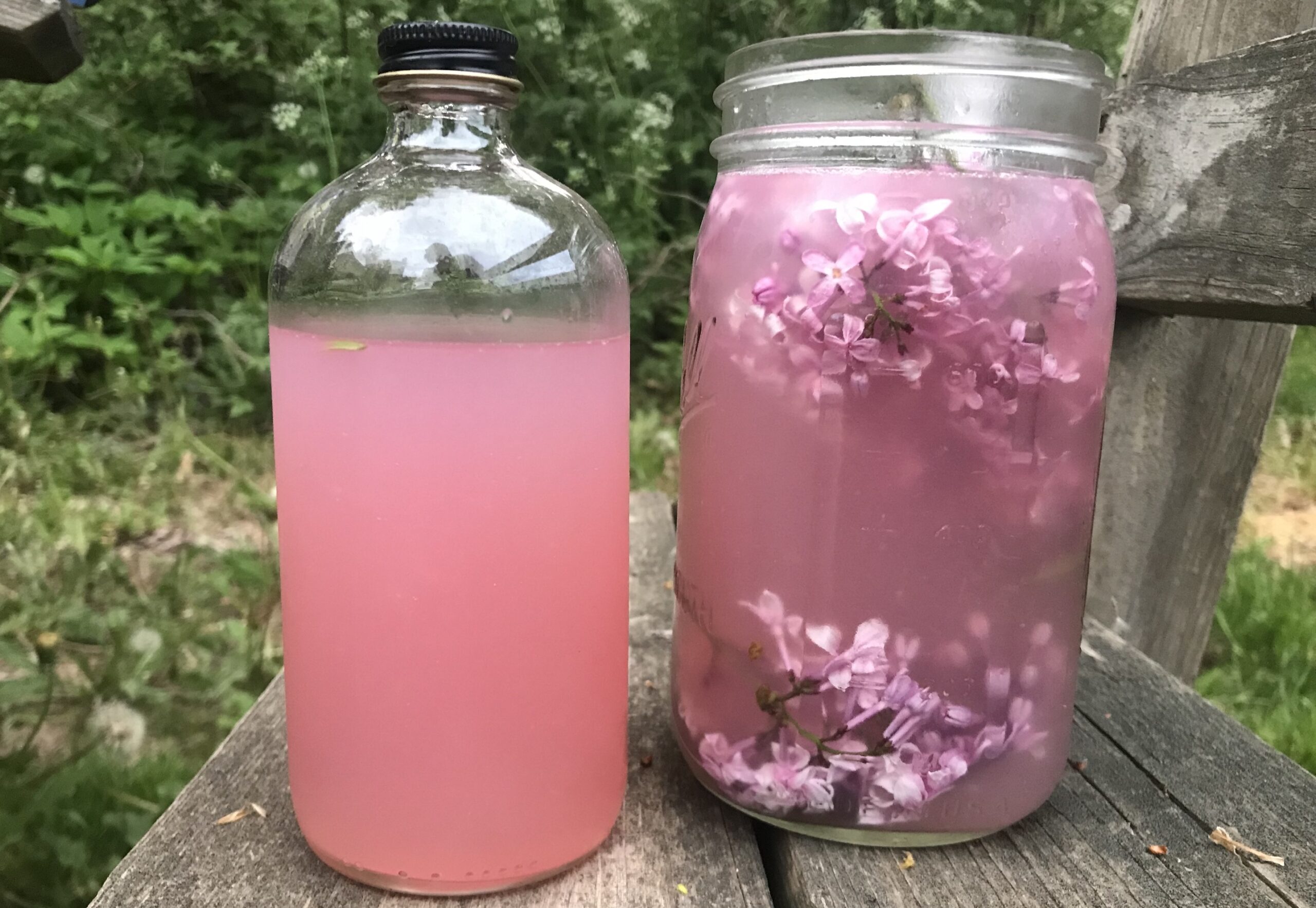
There are all manner of syrups and mixers that you can make with spring blooms: but one plant we haven’t covered here is lilac because it has such a short window of blossoming. It has reached its prime in the last week here in the Catskills. Lilac has such a distinctive, unique flavor and pairs well with any citrus, but tastes better in lemonade. To add a little body, add some thyme to the mix to make this a mixer that works better with gin.
For A Lilac Lemonade (with or without thyme)
Pick a ziplock bag of blooms for every mason jar. Cut them off the stalks. Stuff only half of them in the mason jar if you’re adding thyme. Add a quarter cup of freshly picked thyme, then add the other half of the bag of blooms. Steep in the fridge overnight and strain in the morning. It will go bright pink.
The sap began to flow at the end of February – 27th – when temperatures rose briefly. Now it’s flowing intermittently when temperatures rise during the day. Equipment is still freezing up overnight and has to be shut down while the lows are in their twenties: 21F, 24F and 29F, but it was 39F last night.
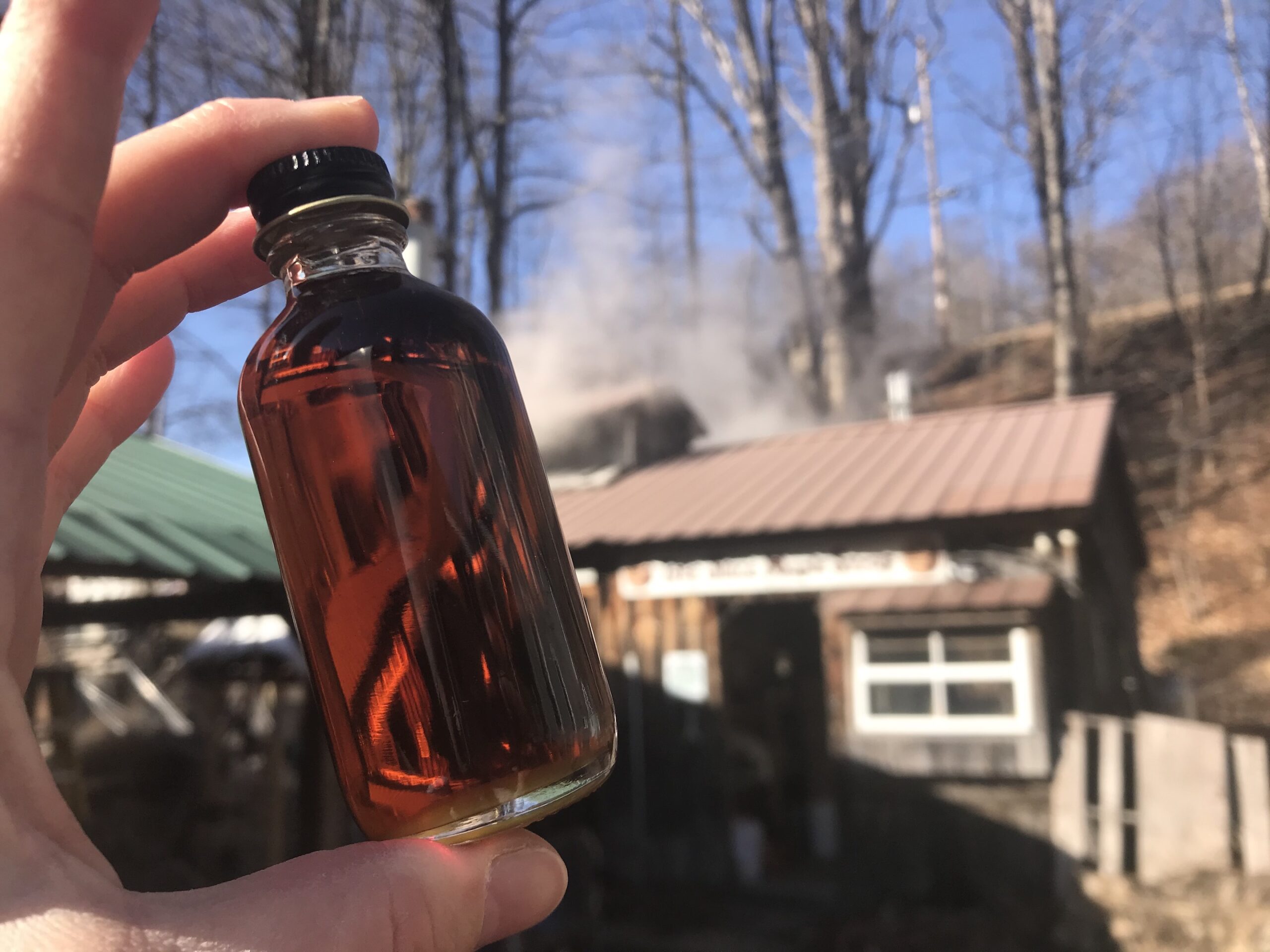
Maple syrup is highly processed, requiring complicated equipment for each stage of production: sap is drawn from the trees through tubing with a vacuum system; the sap is then passed through a reverse osmosis machine that removes water and makes the sap more concentrated. (This process produces purified water called permeate.) The sap is then boiled to about 220F, then clarified through a filter press. The boiling point varies with atmospheric pressure.
The amount of sap that each tree produces depends on the girth of the tree. Each tree makes roughly one quart of finished syrup. One gallon of syrup will start life as roughly 42 gallons of sap this year, the ratio being dependent on how sweet the sap is. The sugar content (measured in degrees Brix: one degree of Brix is one gram of sucrose per 100 grams of solution) of the sap now running is 2%. Tree Juice Maple Syrup has two sap bushes: the Red Kill sap bush has sweeter sap than the Rider Hollow sap bush, which has more red maple than Red Kill. If enough sap flows on a warm day, boiling continues all day and night until the collection tank – 6300 gallons – is empty.
The final product is subtly sweet, not overwhelmingly so, and tastes smooth and earthy: nature’s amber nectar.
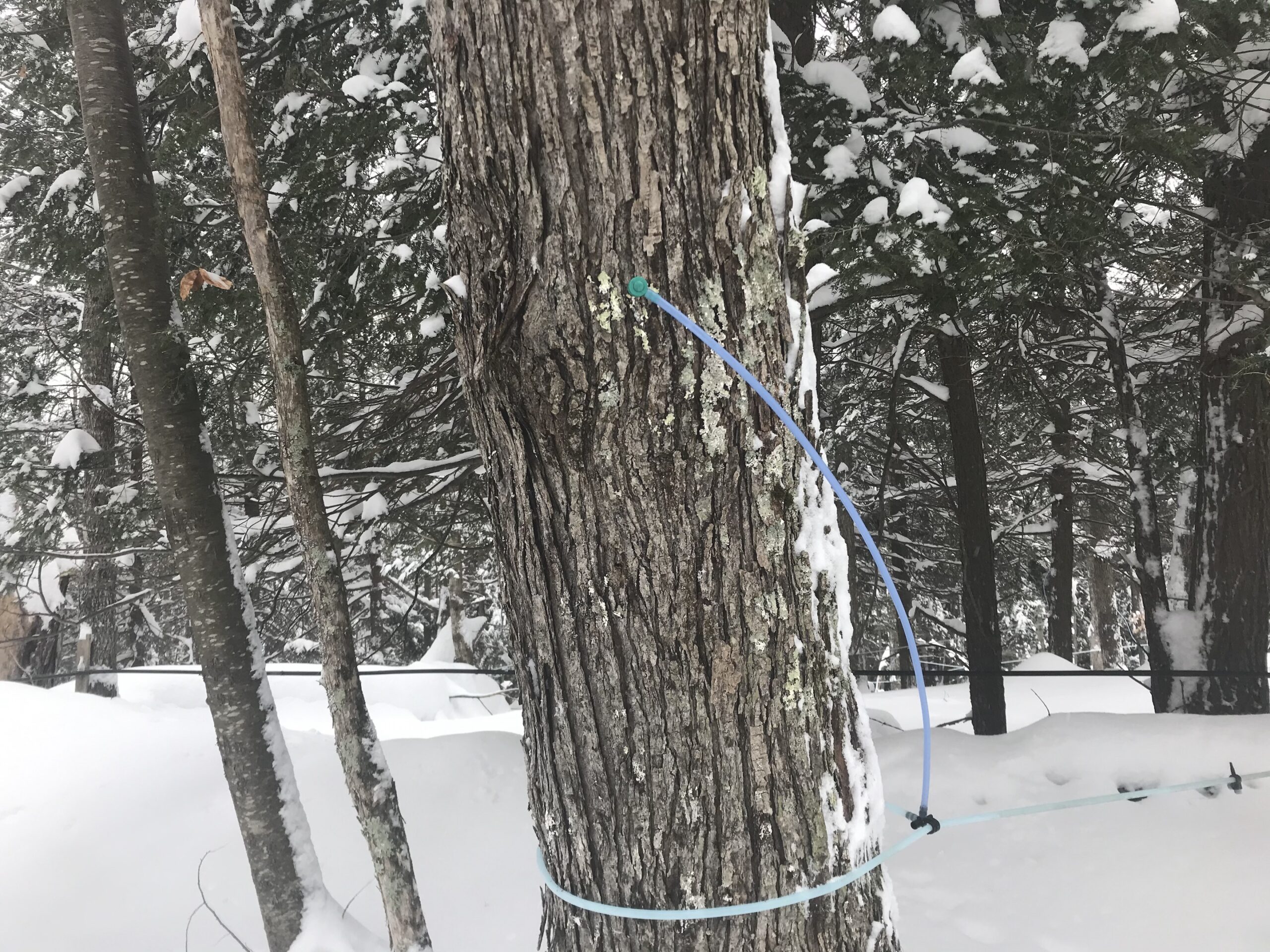
Maple tapping has begun and it’s complicated, arduous, physical labor in freezing cold weather. The “sap bush”, which is an area of trees that get tapped, needs specific equipment and so does the person doing the tapping. Each tree gets tapped by hand in a different place on its trunk each year and some of the tubing – called a dropline (in darker blue above) – is replaced. The sap line (in turquoise above) stays in place. Every year the tree gets a new tap and Tree Juice Maple Syrup has roughly 8,000 taps to replace. Tapping began this year on January 31st, 2021 in 15 degrees Fahrenheit and it continues this week even in a foot or two of snow, into which even the snow shoes are sinking.
“The tap network is a lot like the body,” says Jake Fairbairn part-owner of Tree Juice Maple Syrup. “The dropline is the capillary, the bigger arteries are the sap lines that lead to the bigger main lines (in black above). As you get more centralized you get bigger and bigger arteries”.
Taproot Magazine, based in Portland Maine, is an ad-free, bimonthly print publication for “makers, doers, and dreamers”, with a focus on food, farm, family and craft.
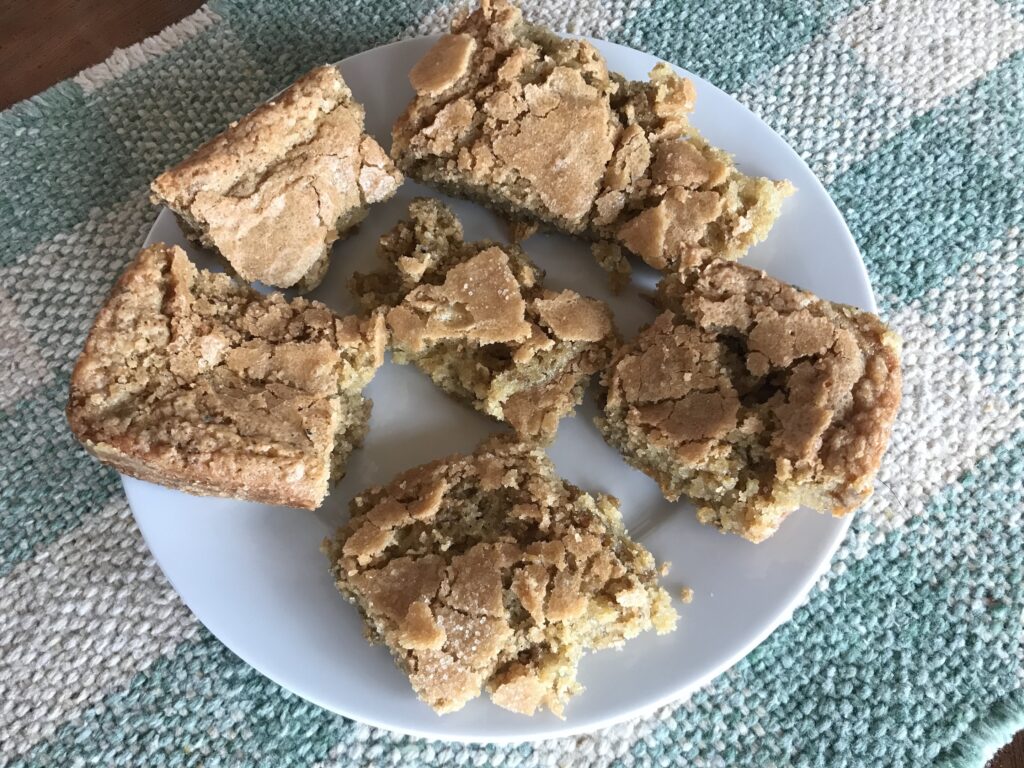
It’s that cake again: my go-to cake, the Heritage Apple cake, but this time instead of mixing the stiff batter with two cups of chopped apple, we’re mixing in a cup of lemon rind that has been steeped over night in maple syrup, the act of which transforms it into something else. Now it’s no longer a cake, but a chewy, lemony, brownie thing. If you like candied peel, you’ll like this. Candied peel is a zesty winter snack for people who still remember eating seasonally. Oranges were rare when I was a kid in London and so they were preserved in sugar when they were in season and eaten at Christmas. We used candied peel in our Christmas cake. This brownie reminds me of home.
I was co-incidentally given a cup of lemon that had been soaked in maple syrup to make Tree Juice Lemon Maple Syrup and, now that my only adventure in 2020 has been cooking, I put it in this cake. And by heck, it’s gorgeous. Here’s the recipe:
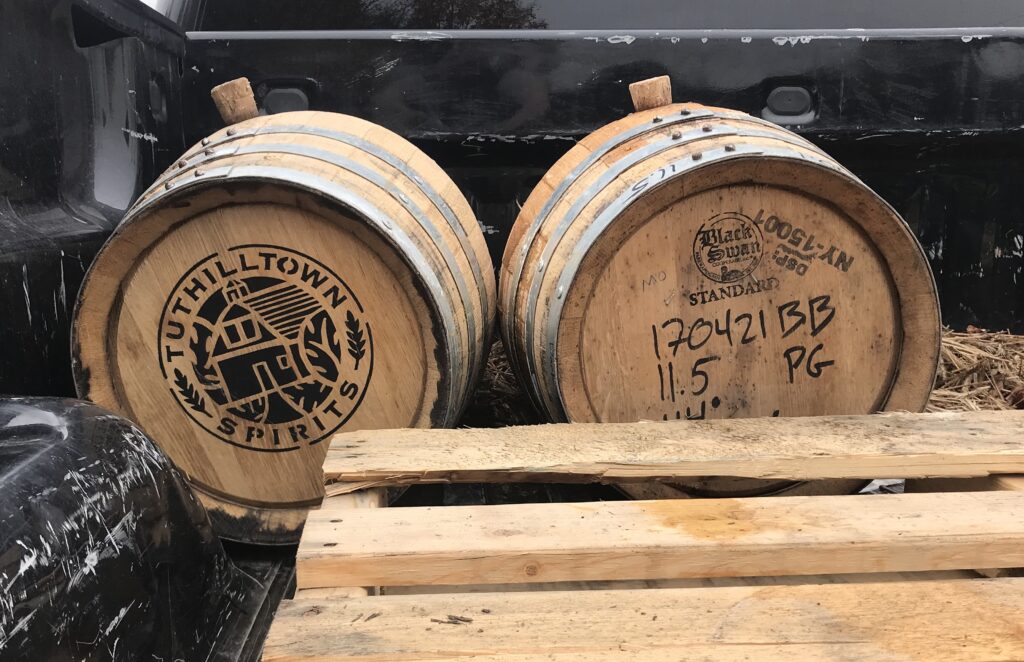
First the barrels had bourbon in them. Then they had Tree Juice maple syrup aging in them. As of 9am this morning, they contained Jenkins + Luekens apple juice, recommended locally as both tasty and well-produced, allegedly the best apple juice in the Catskills which is UV light-treated (cold-pasteurized). JL Orchards based in Gardiner, NY, have 200 acres of apples and other fruit like peaches and plums.
Now is a good time to experiment with cider making; apple season is winding down but there are still plenty of apples left. One 10-gallon barrel (pictured above) will be used to ferment the juice into hard cider that will spend its entire production life in the barrel. Perhaps we’ll go a little wild with this barrel, remove the bung and leave it to take on ambient yeast. The other barrel will be decanted into two five-gallon carboys with champagne yeast, fermented into hard cider and then returned to the bourbon barrel for aging.
This will be intensely flavorful Catskills juice. Watch this space.
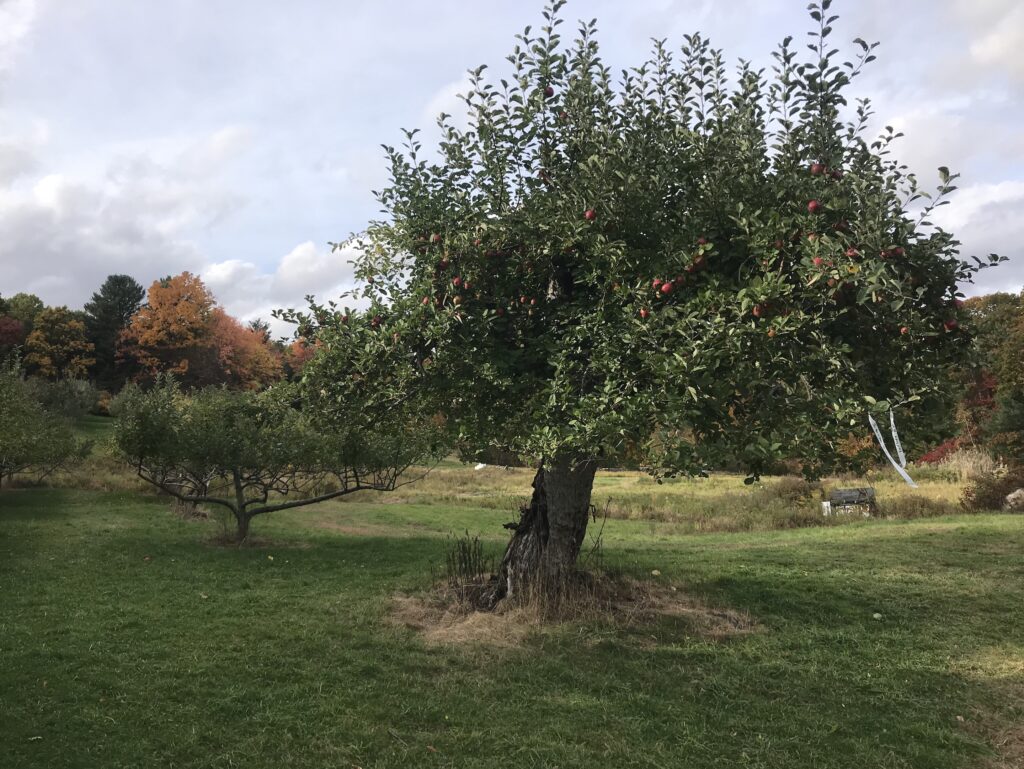
Wightman Fruit Farms say that they’re closed on their Instagram account, but we found them open for picking yesterday from their small selection of heirloom apples and grapes. If they close this week, you can still pick apples from their cooler and put cash in the box. Wightman’s have an historic, 150-year-old tree called The King of Tomkins (pictured above) that is still full of fruit. The apples are larger than usual, crisp and juicy. They made a beautiful apple crisp.
Wightman’s charge $15 for a peck of apples, $25 for the honey crisp. If you’re still looking for outdoor dating ideas, you’re not going to get anything more romantic than disappearing amidst the rows of low-rising fruit trees, especially as the temperatures are still hovering around 60F until Saturday – the forecast calls for 70F on Thursday. Call ahead first to see if farms are open. Some farms in the Hudson Valley still operate if you pre-book an appointment, or their farm stands are open.
JL Orchards in New Paltz still had apples to pick this past weekend. Check their website for their apple picking update. Wright’s Farm in Gardiner were open last weekend and they are dog-friendly. Wright’s farm market is open year-round. Stone Ridge Orchard in Stone Ridge has a farmstead and a farm bar with pizza, cider, NYS beers and wine tastings. They have U-Pick apples now. Call them for availability.
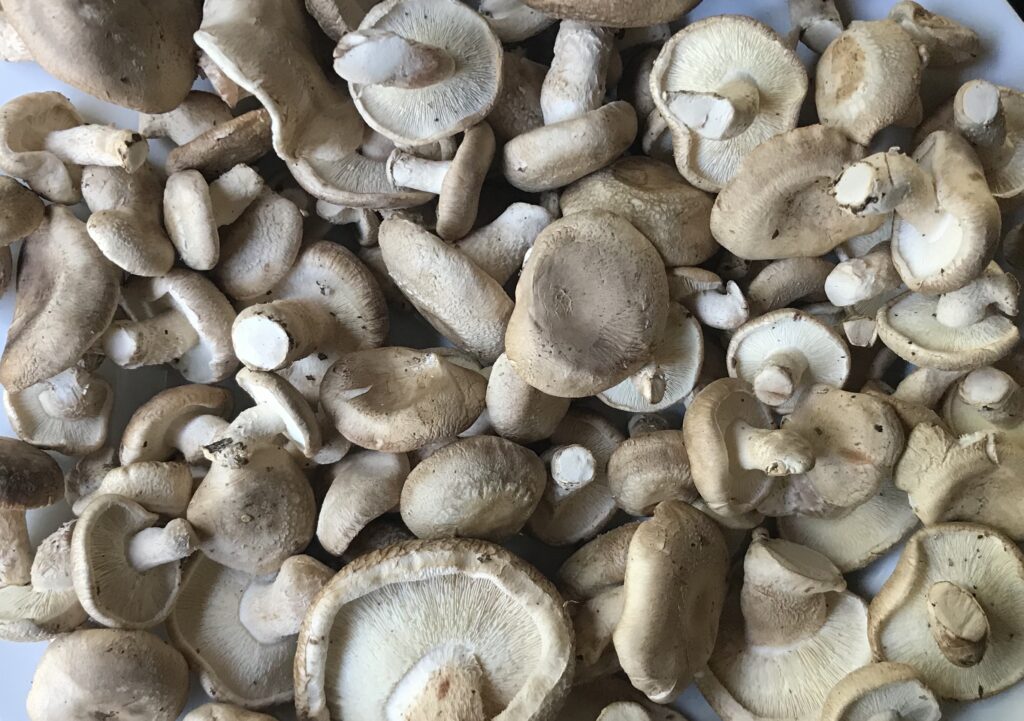
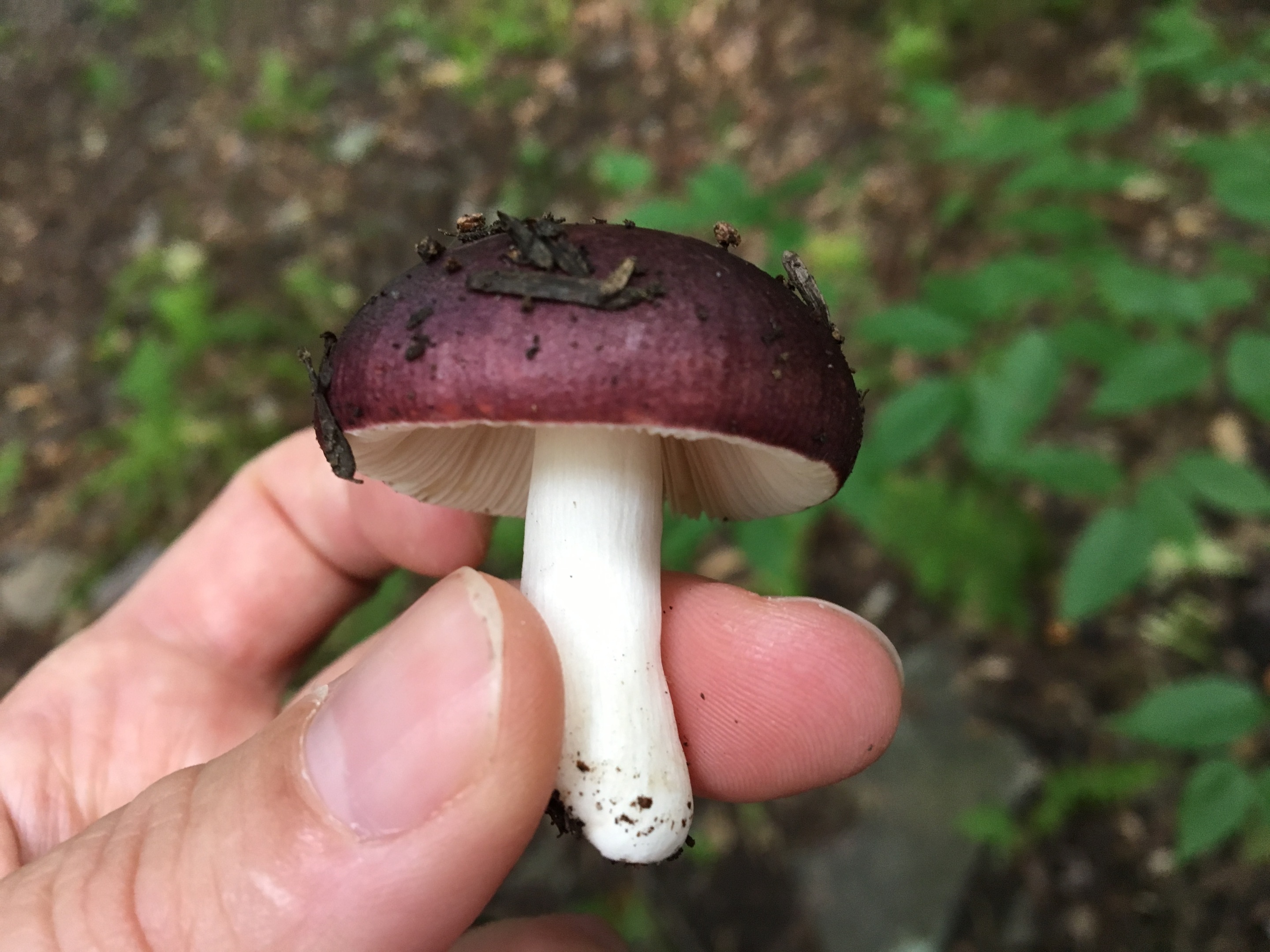
October 15th, 2020 was National Mushroom Day, but this passed by unnoticed around here because rest assured that every day here at Upstate Dispatch is mushroom day. The obsession is feverish around these parts for mushrooms of all kinds.
Mushrooms are one of the world’s most sustainably grown plant – they’ll even grow on coffee grounds – especially if they’re foraged. They’re part of nature’s fascinating underground network of information and nutrients passed between trees and other foliage called mycelium. Not only to do they give a superbly bold, earthy flavor to soups and sauces, but they’re also high in Vitamin D (unlike any other food) a notable mood-lifter in dark months. Mushrooms are a good flavorful substitute for meat and they’re high in soluble fiber. Other nutrients they provide are Vitamin C, B, potassium, copper and selenium. They’re also being used to make bio-degradable packaging and in cleaning up the environment. Here are some great resources, information and recipes on this astonishing organism.
It’s raining today October 16th in the Catskills, so mushrooms should be popping up everywhere in the next 24 hours – this weekend should be a prime time for foraging.
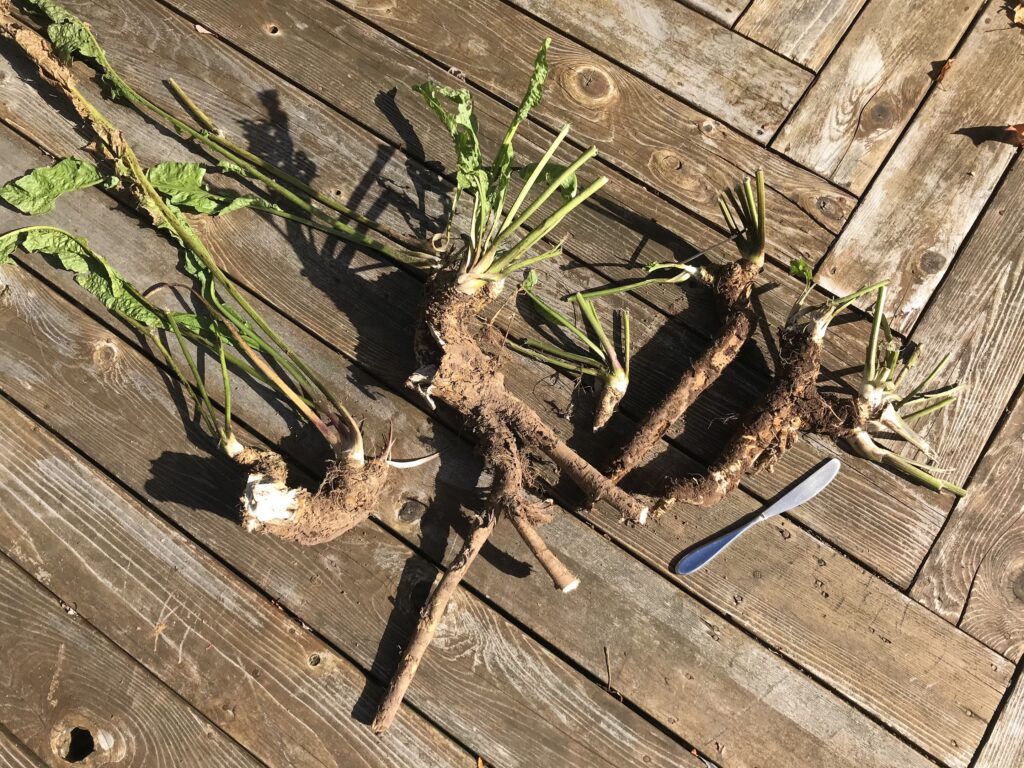
Horseradish is a spicy root of the Brassicaceae family of vegetables (that includes mustard, wasabi, broccoli, cabbage, and radish), that looks rather like a white, gnarled parsnip. The roots run deeply into the ground and the edible leaves that are bigger than rhubarb leaves, but long and thin instead of round, can grow to four or five feet in height. It’s easy to take credit for a huge horseradish crop, but the reality is that you can never really be rid of it. Once you try digging it up out of the ground, you realize that it’s tentacle-like roots travel far and wide around your garden, so you have to stop digging at some point. Whatever root is left is sure to pop out of the earth and produce leaves the following year. If you like spicy food, it’s a really easy crop to grow because of the low maintenance, frost resistance and it’s prolific growth rate. Hot peppers are much fussier than this hardy root.
Horseradish is most commonly found in a sauce with vinegar, but vinegar plus horseradish seems a little excessive: do we really need to suffer that much? I don’t. You can make it a little gentler on the palette by grating it into a condiment like mayonnaise or ketchup, or soups, or finely grating it into a hollandaise to put over eggs for a spicy benedict. It also goes well in a creamy butter sauce for venison or steak.
Store unwashed horseradish root in the vegetable drawer of the fridge. Once washed and grated, it should be put into vinegar to preserve it, but it must be used within six weeks.
Horseradish root is high in fiber; said to improve digestion and metabolism and contains a variety of nutrients like calcium, potassium, folate and Vitamin C.
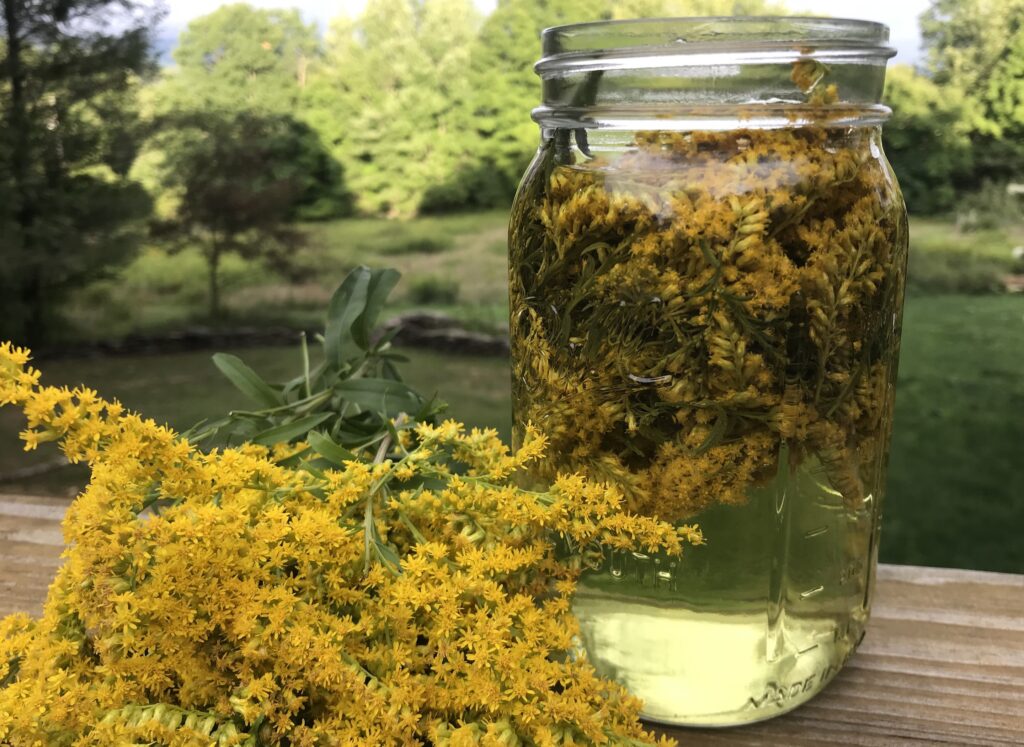
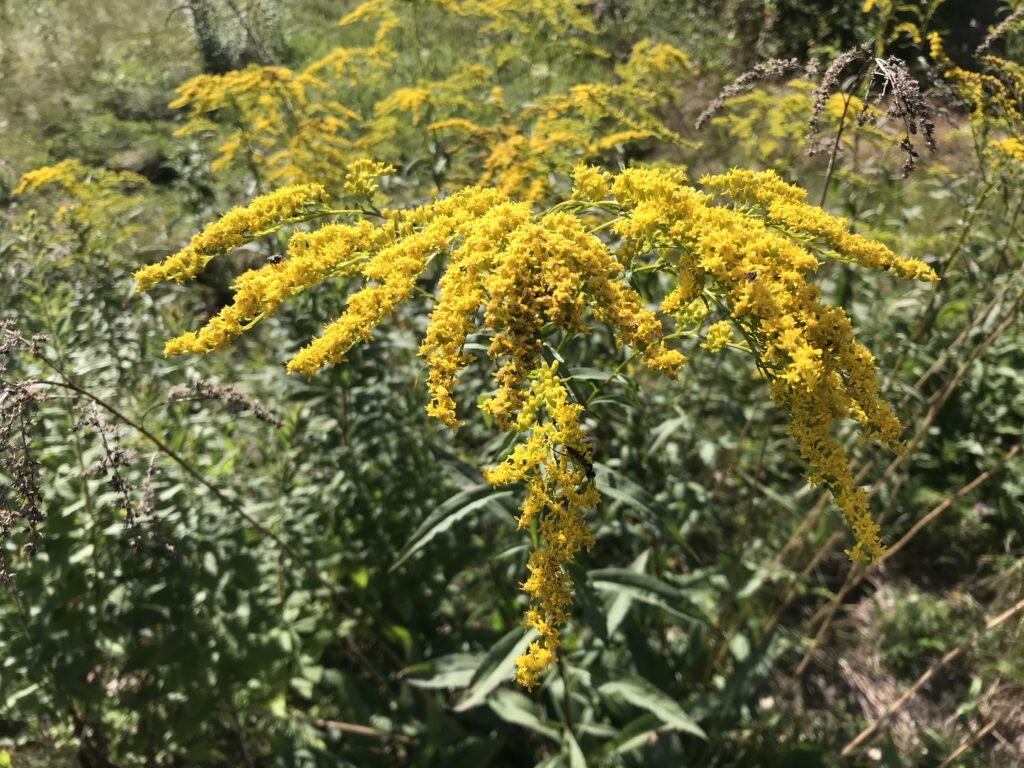
The wild goldenrod is in bloom and makes a tasty and healthful tea. It grows by rhizome and you’ll usually find whole fields of it. They are tall rods, about three to six feet high with hand-sized draping clusters of many tiny vivid yellow blossoms at the top of the rods. Thin leaves, two to six inches long, grow all the way down the stem alternately, and are hairy.
Put fresh blossoms into a mason jar of hot water (not boiling) to make a delicious fresh tea that tastes like a strong green tea. Sweeten with a dash of honey.
Goldenrod is said to have a number of health benefits. It soothes a sore throat, reduces pain and inflammation. It is also used for gout, joint pain (rheumatism), arthritis, as well as eczema and other skin conditions.
The flowers don’t freeze well, so if you want to save some tea for winter, make a condensed batch and freeze to dilute later with water. To make a condensed batch of tea, simply soak as much fresh goldenrod as you can fit in a mason jar of hot water. Strain through a sieve and freeze.
The last year has been quite an extraordinary one, maybe even the most extraordinary year of my life and quite an incredible experience. The upshot is that I quarantined alone on this hill for over three months without any human contact. I had split up with my husband last August and our farm lay abandoned as I considered my options: go back home to England? Move back to New York City? I tried both, then along came Covid-19.
We had made a mess of beekeeping too. Someone suggested that we smear honey on the outside of the hive, for some reason that I can’t remember, and the bees just kept getting robbed until they absconded for good.
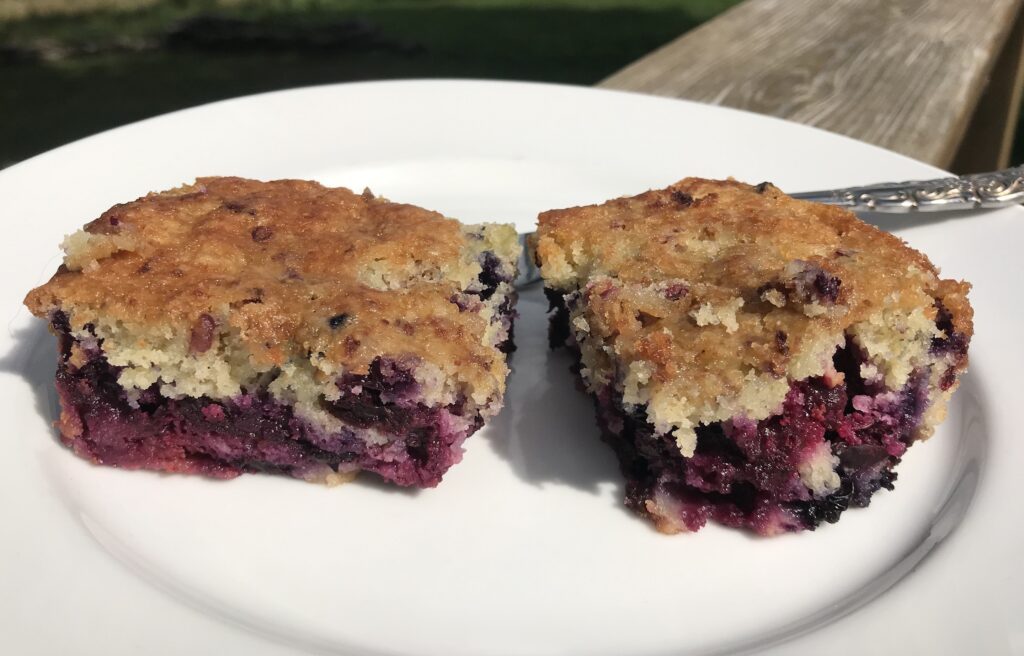
We had an extraordinary year for apples in 2017 and one of the guests on my radio show at the time gave me a fabulous recipe for a Heritage Apple Fruit Cake that is my one go-to cake. This is turning out to be a poor year for apples on our farm, so I’m using blueberries because I have so many of them. I’ve also modified this recipe even further because I like my cake really moist, chewy and fruity, so I bake it in a flatter pan, for less time and I’m using an extra half-cup of fruit. The special thing about this cake is that all the fruit sinks to the bottom and you get half-fruit, half-cake pudding with a slightly crispy topping that is really delicious. Needless to say, if you need to have your cake thoroughly cooked all the way through extend your cooking time to 40 minutes.
Fruit Cake
1 cup AP flour 1 tsp baking powder 1/2 tsp salt 4 oz butter (1 stick) 1 cup sugar, plus one tablespoon for sprinkling 1 tsp vanilla 3/4 tsp almond extract 2 eggs 2.5 cups blueberries
Soften the butter and whip it together with the sugar, vanilla, almond extract. Add the two eggs and beat them in. Mix the whole mixture well. Sift the flour and baking powder and add it into the butter/sugar mix gradually. Mix until you have a batter. The batter will be very stiff. Once you have a smooth batter, gently fold the blueberries into the batter but do so very gently – trying not to smash the fruit. You will end up smashing the fruit, but just try not to. Put the mixture into a square, flat, greased cake tin (9x9x2 inches). Flatten it into the pan gently and sprinkle the top with a tablespoon of sugar. Bake on 350 degrees for 30 minutes. (Or if you need your batter thoroughly cooked all the way through, do 40 minutes).
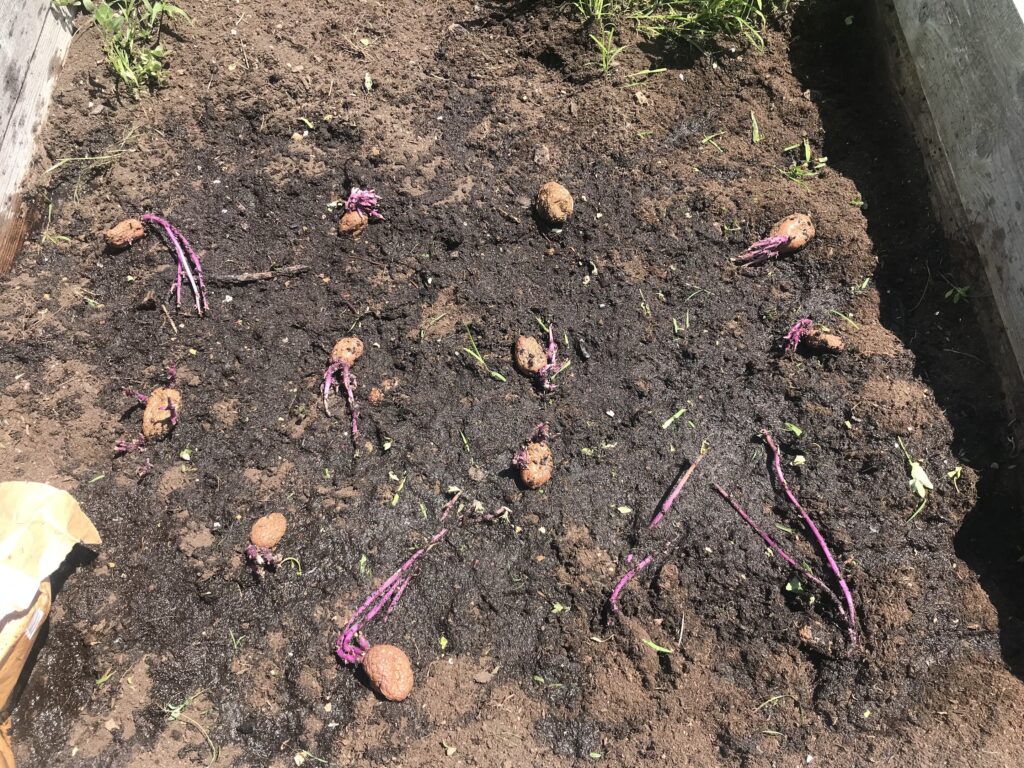
I’m writing a book, so the farm has gone “holistic” for the last week or two and I’m producing a great deal of seeds. Even some of the purslane has blossomed yellow flowers. I’m allowing the asparagus to grow wild, so that the roots will benefit for next year’s season. I also let the Adirondack Red spuds linger too long in the kitchen and they wrinkled up, went moldy and sprouted. The good news is that they smell weird, so the chipmunks won’t go near them. I received a farming pro-tip: throw them in the bed and cover them with straw. Keep the straw wet. I’ve no idea why. It took five minutes in the scorching 90F weather today, so I felt a small accomplishment. We’ll see what happens.
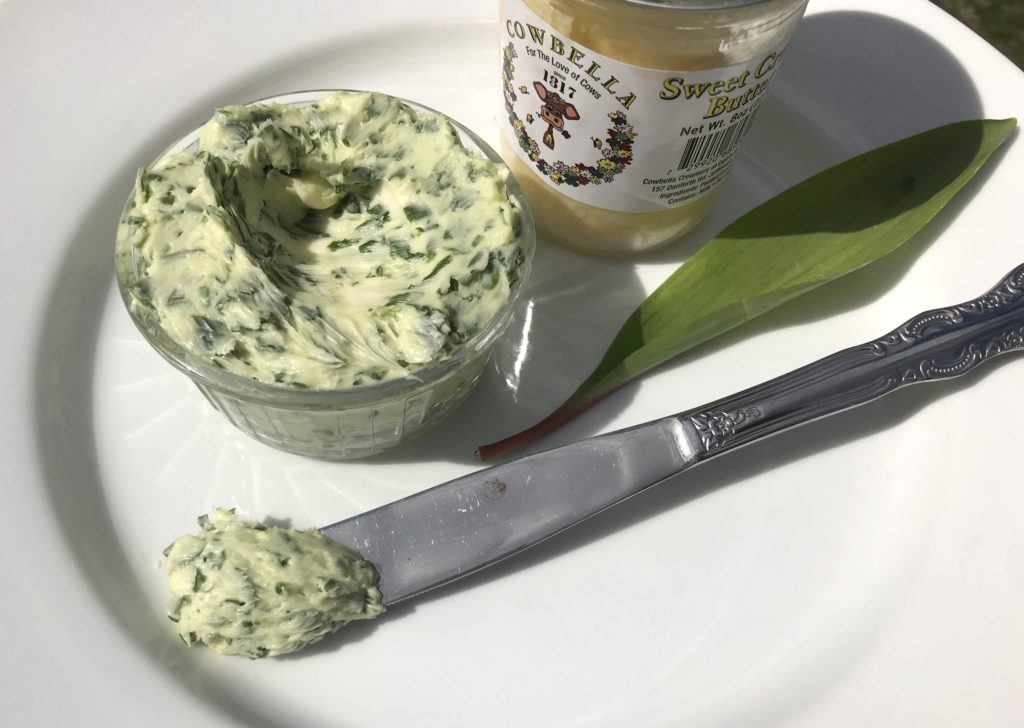
Using the last of the ramp (wild leeks) as the season comes to a close: ramps can be mixed into butter. There are many anecdotal recipes across the Catskills. You can blanche the leeks first in hot water or heat the butter, but the best way to get the taste of the plant and all its raw nutrients is to just finely chop the ramps and mix them well into the butter. You’ll get the sweet onion taste, but not overwhelm the dish to which you add it. A knob of raw ramp butter on a steak or steamed fish, for example, will complement it well. You can add a couple of tablespoons of this butter to a stew before you serve it. The butter above will be going over roasted asparagus and into a Guinness stew.
Chop the ramps on a plastic surface, so you don’t lose any of the juice into a wooden chopping board. Soften the butter slightly – I tuck it in my armpit for a few minutes – and then fold the ramps into the butter and whip it for a few minutes. Ensure that every part of the chopped ramps are either fully submerged in the butter or, if the ramps stick out of the butter slightly, that they are thickly coated in it. You don’t have to worry about this too much if you freeze the final product, which makes it easier to handle. If you do freeze it, roll it in to a log, or similar shape to a stick of butter and wrap it in the discarded butter wrappers, so you can cut it into knobs when you use it.
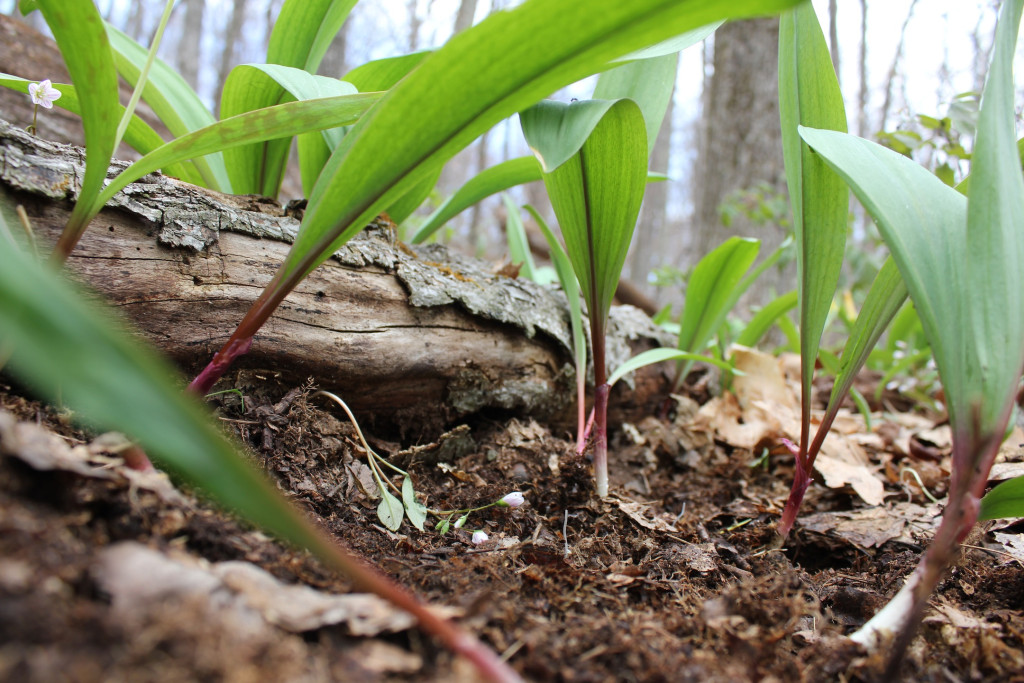
It’s wild leek (ramp) season and this year we’ve had more than the usual amount of rain needed to nourish these delicate, wild beauties. Every local in the Catskills has their secret ramp spot and few years ago, I transplanted a handful of wild leeks to a shady, wet spot by our house that they love. They love a water source and our house at the top of a ridge has brilliant underground drainage, so when it rains, all the water flows downhill through the ramp patch. Our patch is now several patches. Just before they die off, they send up stalks with dark, perfectly spherical seeds that look like tiny balls of onyx.
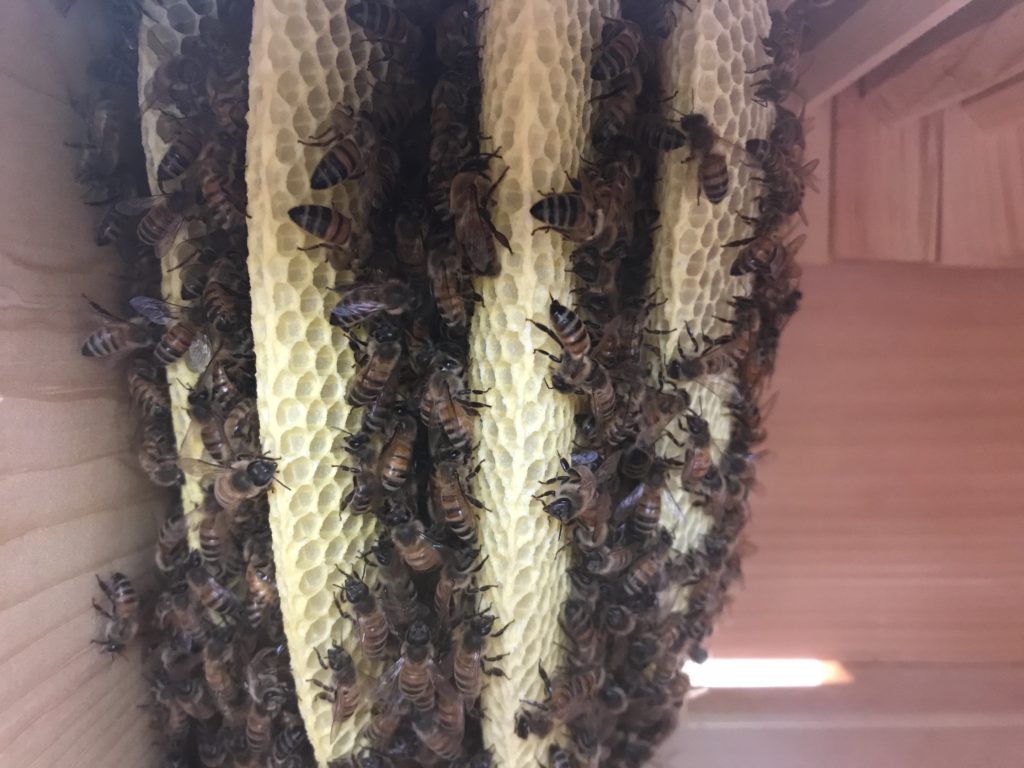
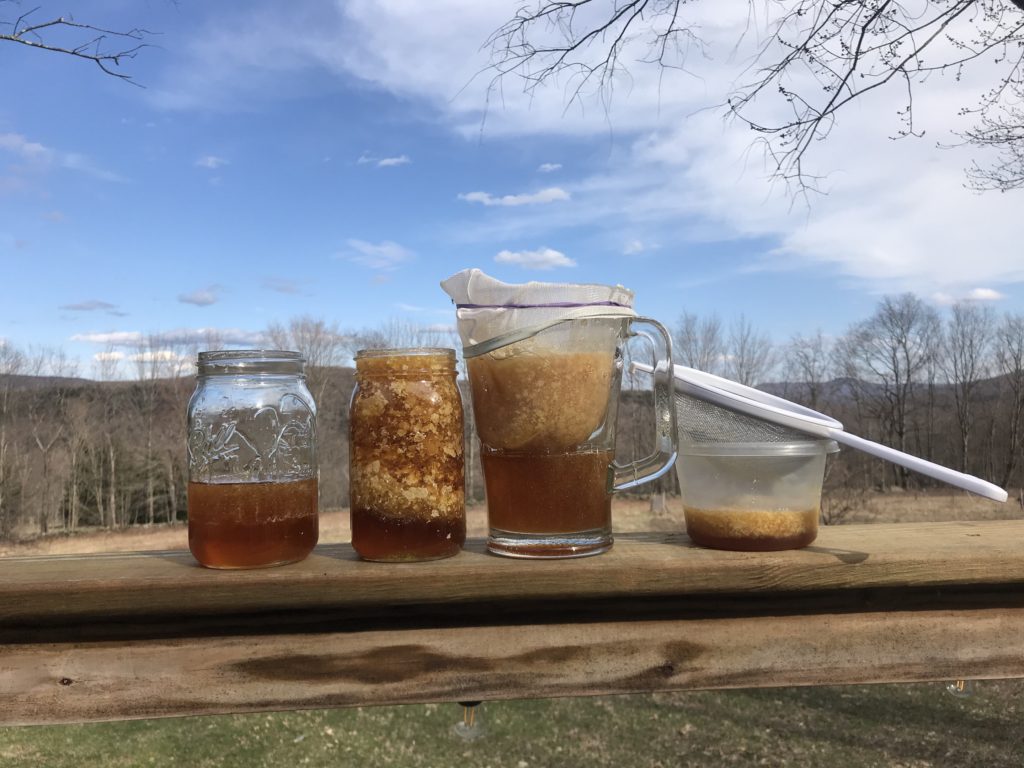
Bee update: the bees left. They must have swarmed last winter because they left a honey super with seven frames of capped honey that had to be processed by hand this week. This took two days with one muslin bag and a sieve. It took four hours to clean up the kitchen. Sticky. We’re all in a sticky situation, so no change here. In fact, the empty frames are still outside in a big plastic tub waiting to be scrubbed.
This is Covid honey, not having been processed in a commercial kitchen and because of the all the finger-licking, probably will have to be eaten by me alone because I’ve no idea if I’m Corona-free or not.
I’ve produced about six mason jars of honey and about five pounds of wax and thinking of ways to eat all this sweet stuff. Breakfast every day is toast with honey using Bread Alone’s health bread – I have few loaves of this in the freezer. What else? Tea with honey, plus if you put a tablespoon of honey and a tablespoon of apple cider vinegar in a glass of water and stir, this makes a healthful and tasty beverage. Well, maybe not tasty, but definitely makes you feel fantastic. Hold your nose and chug it down.
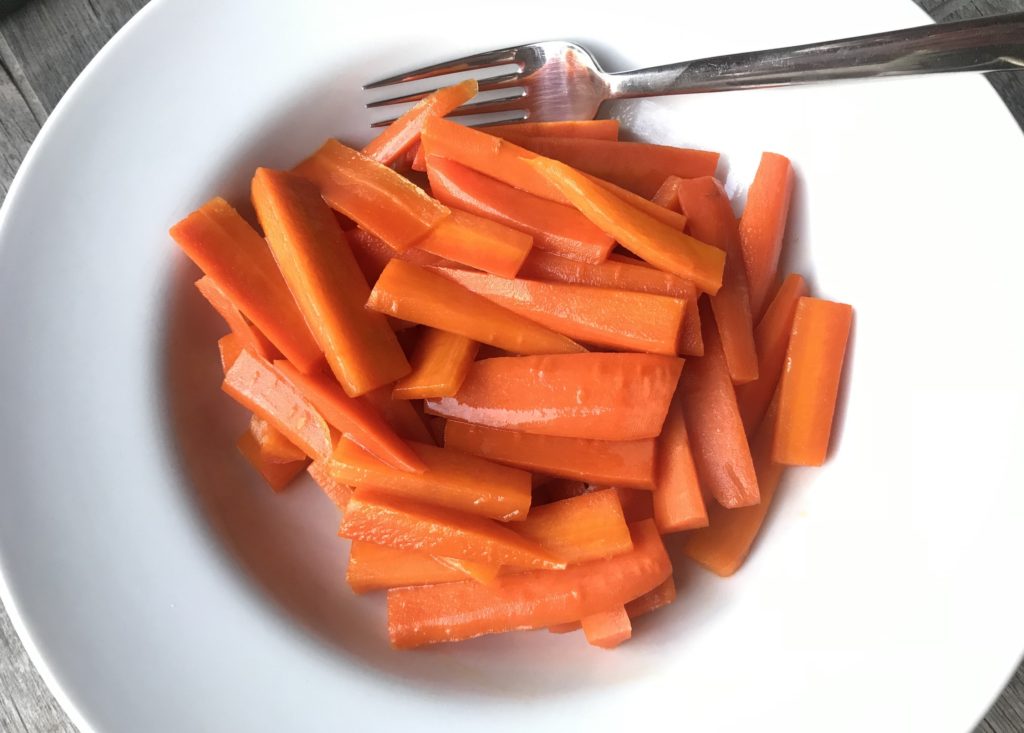
Recipe ideas welcome in the comments section. Please! Meanwhile, here’s what I did with some carrots. And then I ate the whole lot with a pint of Ommegang Rare Vos. Drink local!
This recipe is really easy. Put two cups of julienned carrots in a skillet with a knob of butter and salt/pepper to taste. Personally, I don’t use either. I just don’t find it necessary because I use local vegetables and they taste great on their own. Stir over a medium-to-high heat for about seven minutes. If the carrots dry out, add a splash of cold water and then put the lid on so they steam for a minute. This adds water. If you do this twice in the first seven minutes, you’ll get a half-inch of buttery glaze that the carrots can steam in. After seven minutes, stir in a quarter-cup of honey over the carrots, wait a few seconds for the honey to liquify, and then stir well over the heat for the remaining three minutes. The carrots will be crunchy and sweet.
The natural world recently got a break when it was deemed that terms like “fire cider” are generic terms and can be used by everyone who makes the product. Companies had previously trademarked the product to stop small businesses and makers like local herbalists from using it. Now they’re able to continue marketing their fire cider products. Go here to learn about making your own fire cider.
Thieves Oil is also an ancient medicinal potion that dates back to the Middle Ages when Europe was devastated by the Great Plague that was so contagious that it killed one hundred thousand of people in London alone, which was a quarter of the population. It was only stopped in London by the Great Fire of 1666 that swept through the city. Before that however, there was a band of thieves that went through London robbing the wealthy people who had succumbed to the plague. The thieves were caught and the judge demanded to ask how they had not contracted the disease and died. They gave the recipe for this natural sanitizer that they had doused over themselves and covered handkerchieves and face masks. It was so potent that it stopped the thieves from contracting the plague.
It’s not often you find yourself, all windswept by the frigid mountain air, sitting cross-legged in your rubber boots in the cozy window nook of a homestyle restaurant listening to the soothing sounds of a sitar. The only thing to do when you unexpectedly find yourself in that situation, after having only gone out to buy soap, is to lean in, kick back and order the curry lovingly handmade by Liza Belle, that is robust enough to keep your warm until dinner.
Last time we met, Liza baked a mass of rich, sweet sticky toffee pudding in her kitchen at home, narrating the recipe as she cooked. This time, it was a delicious Thai green coconut curry with jackfruit: perfect to stave off the winter blues. Jackfruit, packed with nutrients and protein, is often used in stews as a meat replacement due to its fibrous texture – it makes a great vegan pulled pork – but it’s sweet and fruity, blending well in this curry with potatoes and string beans. The fragrant jasmine rice was perfectly cooked. A nice bonus was the lightening, cooling effect of the starfruit garnish. This was a proper curry, not for those with weak taste buds. Brace yourself for the full flavors and strong spices.
Also on offer was a dal, a thick lentil soup with braised kale.
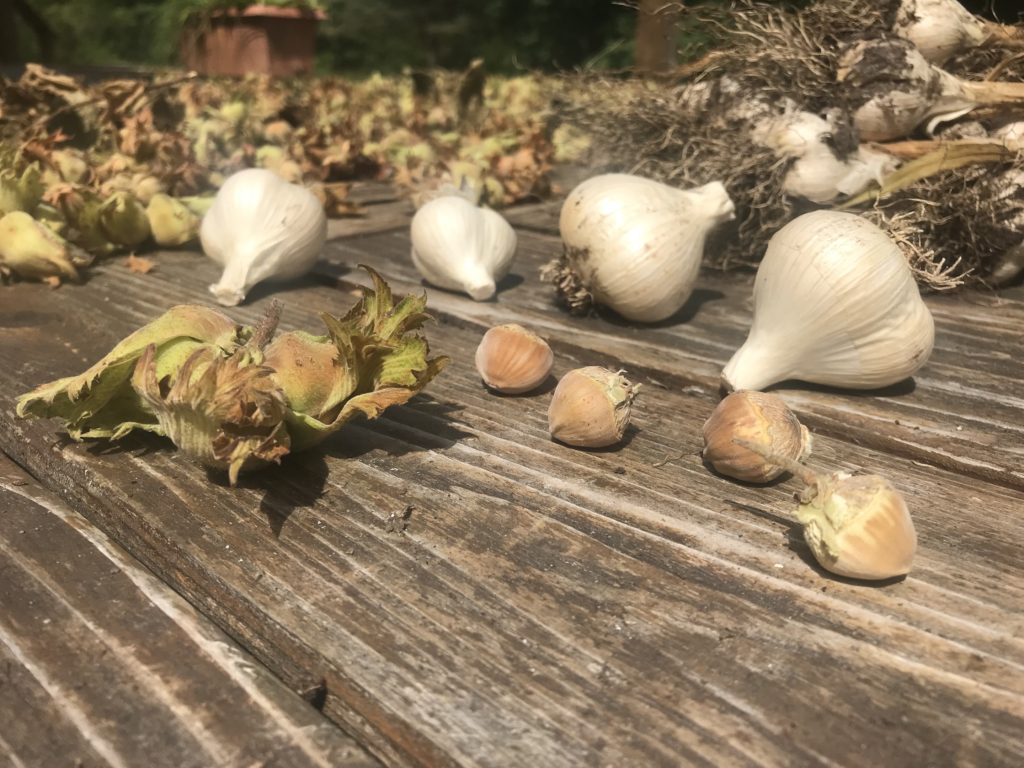
Summer in the Catskills is coming to a close. The bees swarmed a couple of times – more on those later – and the farm is growing over with thistles and blackberry bushes. Goldenrod has taken hold like the rays of some sort of eternal sunrise; hazelnuts and apples are being harvested; garlic has finished curing; horseradish root is being turned into sauce. Have you ever peeled the outer coating of a hazelnut? I’ll be here for days, but it’s worth it for what looks to be about 20 pounds of hazelnuts, possibly more.
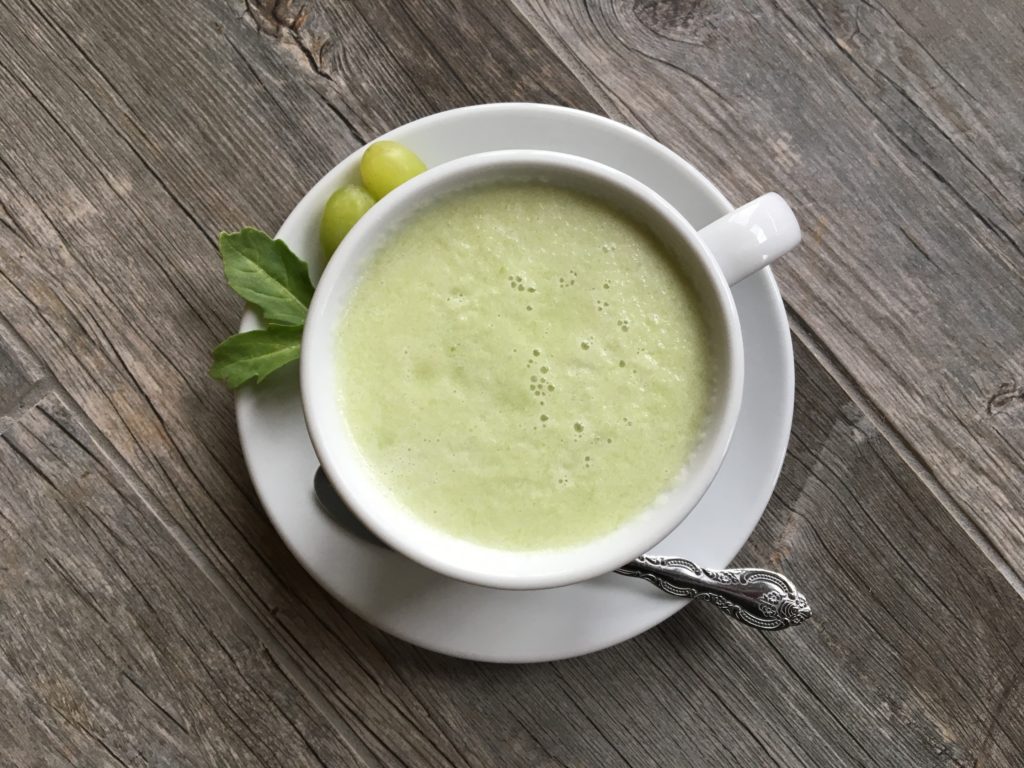
This is an update of our recipe from a few years ago, because now you can buy almond milk. There’s no need to soak almonds overnight and strain them to get their milk. Cucumbers are in season from July through October and this refreshing, sweet chilled soup is the perfect antidote to our scorching recent Catskills weather.
Cucumber Gazpacho
Three medium sized English cucumbers Three cups of almond milk, unsweetened Half cup of water An apple, peeled, chopped and cored or 10 grapes Three teaspoons of olive oil Half teaspoon of salt Half teaspoon of pepper
Puree the grapes in a blender, sieve them and save the liquid. Peel, chop and puree the cucumbers in a food processor until they are liquid and while the cucumbers are blending add the olive oil, salt and pepper, grape juice and almond milk. You might also like to add a little of the almond or grape pulp to garnish with a splash of olive oil. Chill before serving. Delicious.
This is the sort of recipe that you can amend without too much fuss. If you want a sweeter gazpacho, you just throw all the fruit – an apple and the grapes – in the blender with the cucumber. (If the result is too thick, add more almond milk.) This also makes a perfect pre-workout smoothie where, if you haven’t had a chance to eat all day yet you still want to work out, you can drink this an hour or two before exercising.
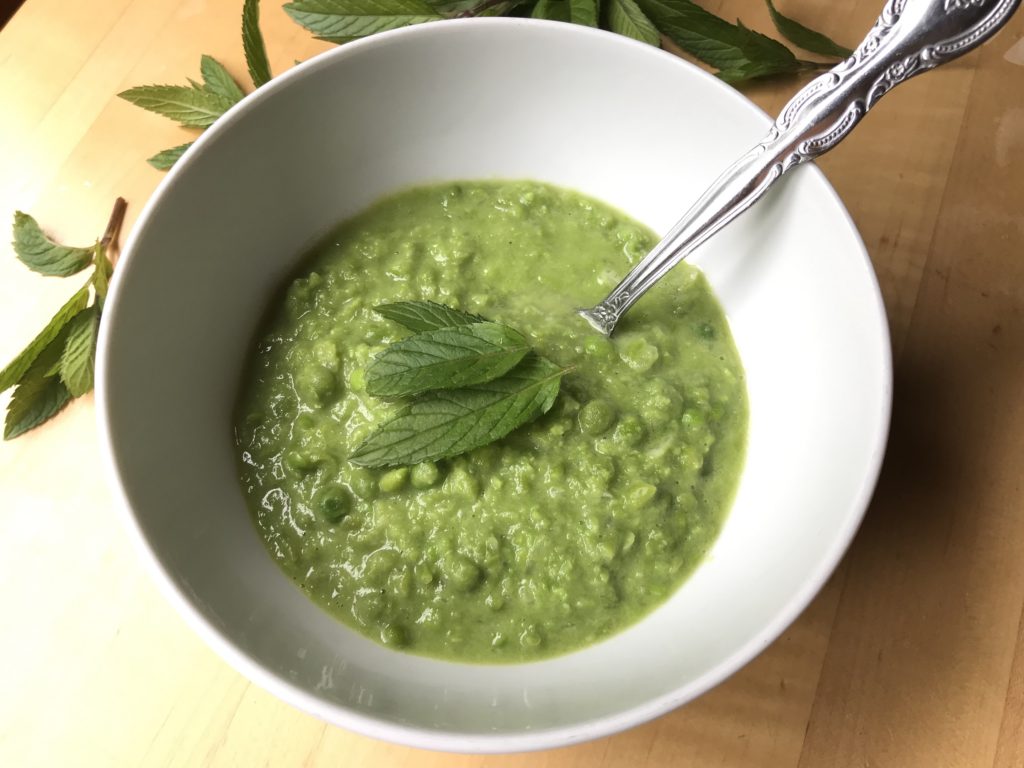
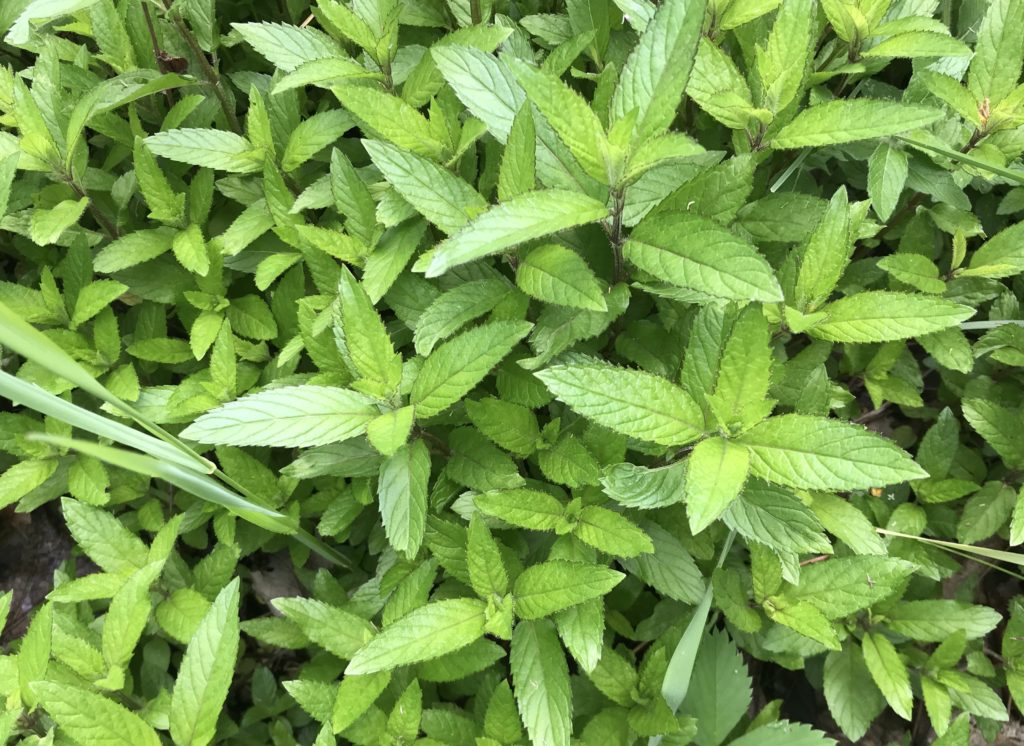
The wild mint is out in force with the wild flowers, but we must wait longer for the peas or find them in the freezer. There’s something about pea and mint soup that screams summer. This is a family recipe, but there’s really nothing to it. Fry up some onions, garlic and thyme in oil or butter, add stock, boil until warm then add peas and mint. Simmer for only a minute, then blend with a hand blender. If you love the taste and texture of fresh peas, use frozen peas and put them in the stock straight from the freezer. They will thaw, but not cook all the way. Only blend half the soup and add a knob of butter in each bowl of soup when you serve it to get the taste of buttered peas with a little crunch of sweet pea. You can also garnish with a dash of balsamic vinegar if you’re not into the butter and want to add a tangy element. If you’re going to go with the balsamic option for the first time, put the balsamic vinegar on the side, dip toasted or warm bread in the vinegar, and dip the vinegar toast in the soup.
Pea & Mint Soup
Half an onion
Two tablespoons of oil
One tablespoon of minced garlic
One tablespoon of dried thyme
One liter of chicken broth, or non-chicken vegetarian broth
One pound of frozen peas
Ten leaves of fresh mint, or more depending on how minty you want it
Butter to garnish
Finely chop the onion and fry it with the garlic and thyme in the oil until lightly brown. Add stock and bring to the boil. Add the peas and simmer for a minute only. Add the mint. Blend with the hand blender, but only blend half the soup. Stir the soup with a spoon. Garnish with butter or a dash of balsamic vinegar. You can make the soup as minty as you like it. Start with less mint first, because you can add it, but can’t take it away once you’ve blended it in. If you want to add more mint after you’ve served it, just pop in a few more leaves into the saucepan, stir the soup and then remove the leaves. Fresh mint will always leave a lot of mint oil behind, so you don’t necessarily need the leaves in there. You’ll notice that there’s no salt in this recipe because there’s enough salt in the broth and, if you over-salt, it clashes with the mint.
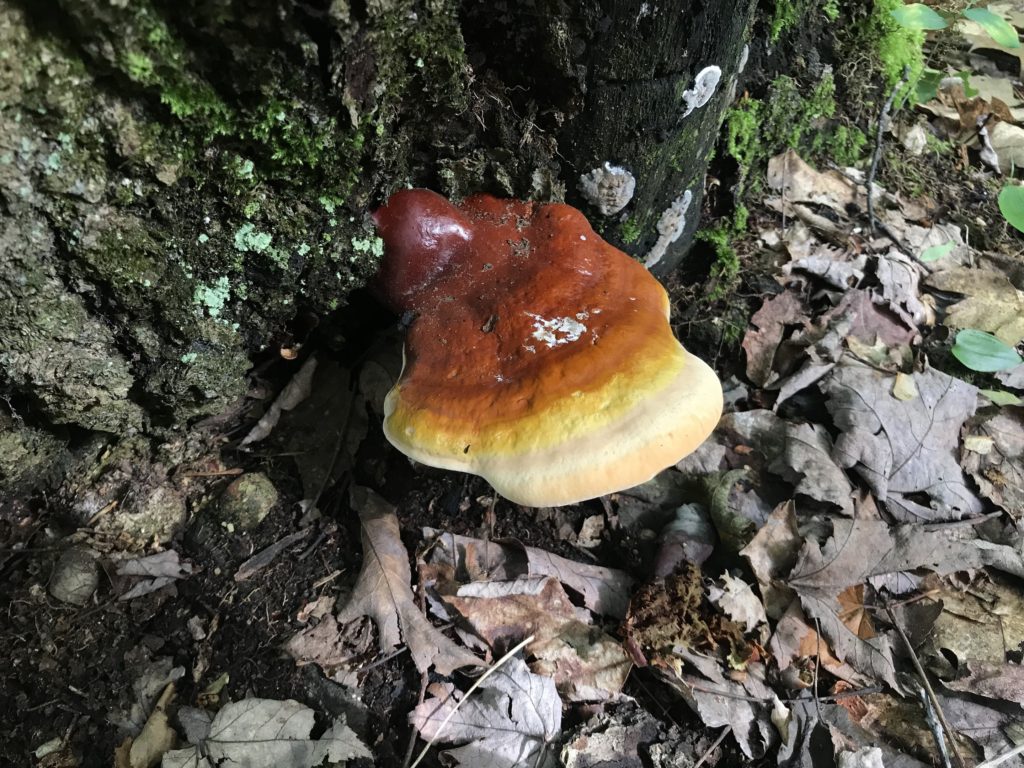
Ganoderma Tsugae or Lacquered Polypore, has many names, but the most popular one is Reishi and it’s out in the Catskills now, mid-June, although it does appear from Spring through Fall. It is sometimes found in Winter months too, but here at the higher elevations, it’s both literally and figuratively at its peak. Other names for it are Varnished Polypore and Hemlock Varnished Shelf. Reishi grows on hemlocks in particular, or can also be found on other coniferous wood. The surface under its cap has pores, not gills, so it is spongy to the touch and, in fresh samples, off-white in color.
It grows directly from dead or living trees or roots of removed trees. The specimen above was growing on a logged tree stump and is the size of a hand, but they can grow much bigger. It causes white rot, acting as both parasite and decomposer.
For millennia, Reishi has been used for medicinal purposes in China. It’s reportedly an immune booster. It’s usually peeled and sliced and simmered in boiling water, with the water drunk as tea, but it tastes hideous. Another form of Reishi (Ganoderma Lucidum) is widely available in health stores as a powder to put in a hot beverage, or hot water, or in pill form.
Here in the Catskills, I know more than one person who claims mushroom supplements have stopped their allergy symptoms.
To store Reishi, put it in a paper bag in the fridge. You can preserve mushrooms by drying them. To do this, slice the mushrooms and arrange them flat on a baking tray. Put them in the oven on the lowest setting (170F) for two to three hours, until they’re fully dried, or buy a dehydrator.
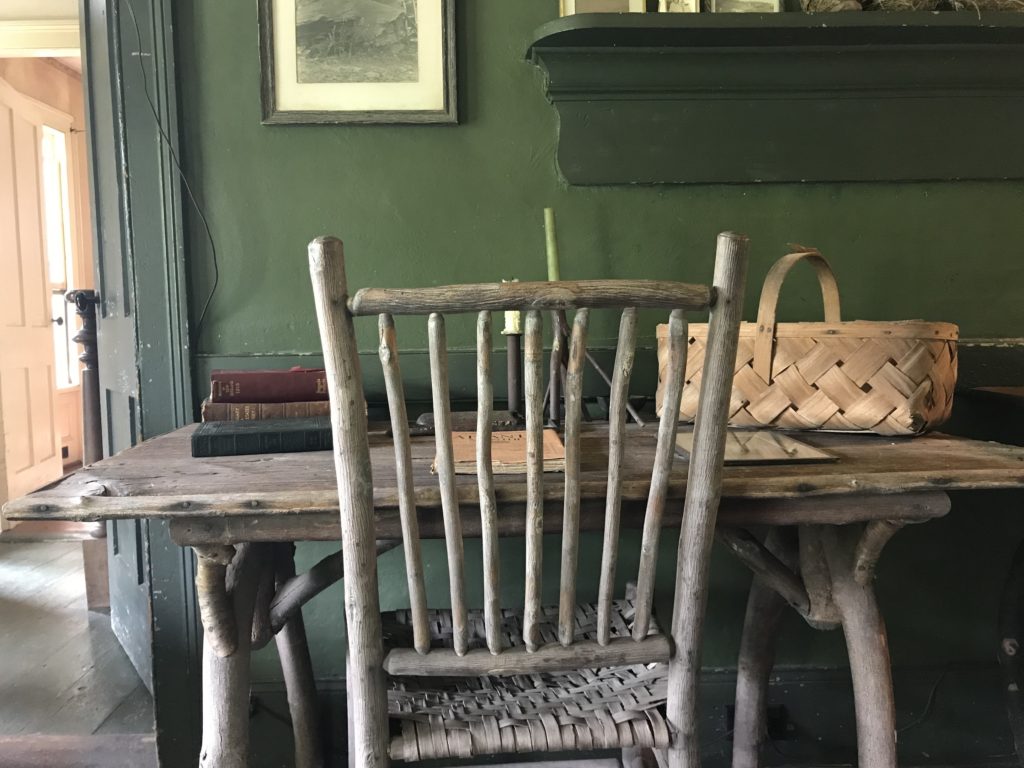
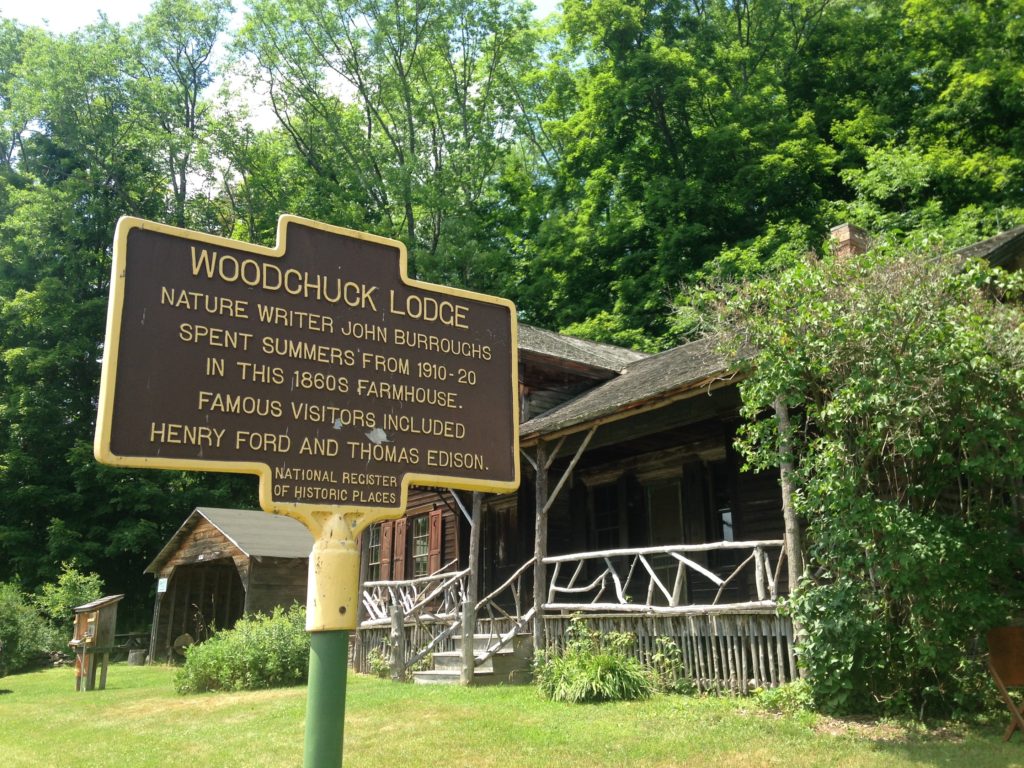
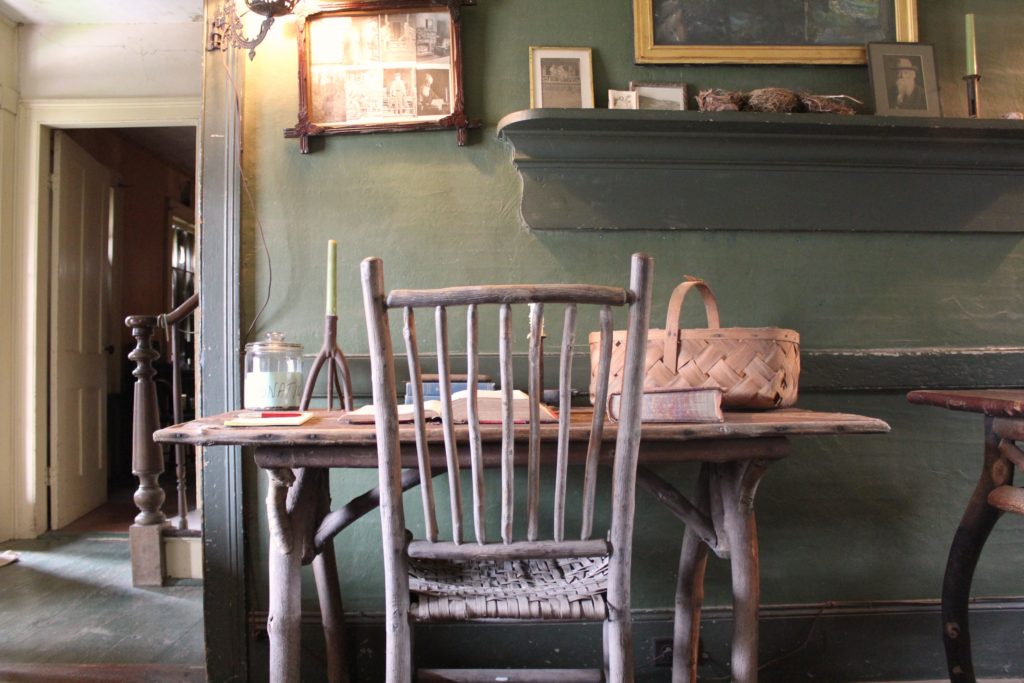
John Burroughs’ writing desk at his home, Woodchuck Lodge in Roxbury, Upstate New York.
Writers might be hard pressed to find a more storied place in the Catskills to work for a few hours than this desk, at over 100 years old at Woodchuck Lodge.
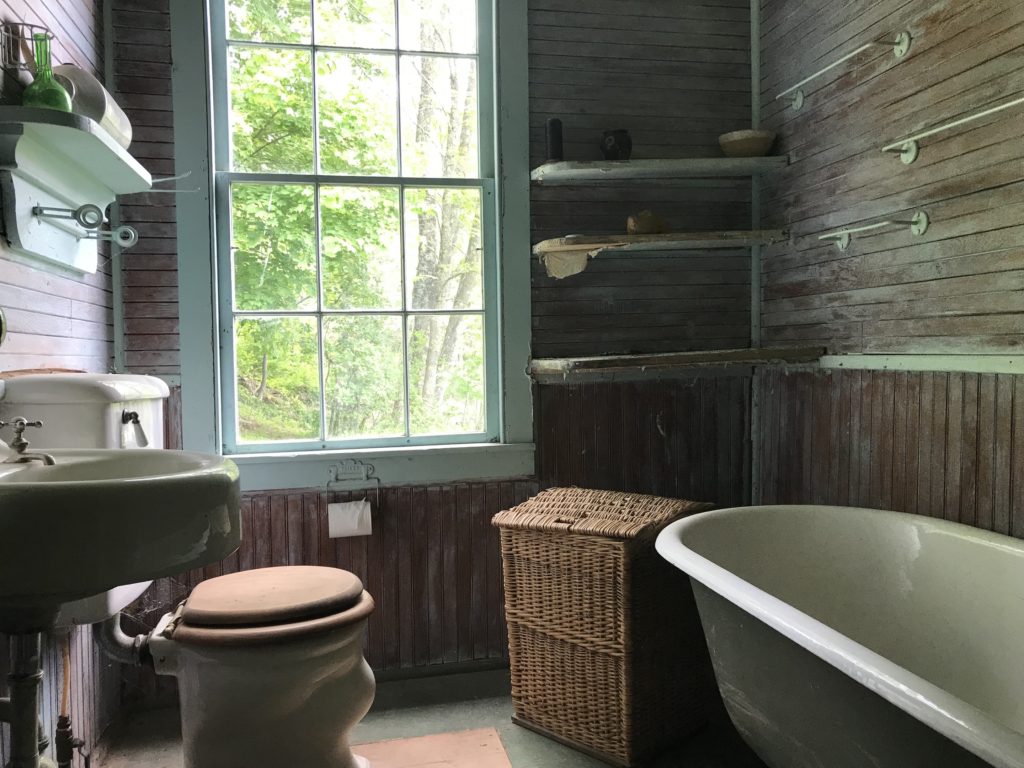
Hipsters ferreting around at Roxbury’s historic landmark Woodchuck Lodge might bypass his fading 100-year-old collection of Atlantic Monthly (still going strong) magazines and stop in the bathroom with a loving gaze. Here’s one part of the lodge that doesn’t need any update, or if anything, the window should be made floor-to-ceiling so that one can bathe in full view of the mountains. It’s the writer’s perfect rustic meditation spot, complete with clawfoot tub and gorgeous light all year around. It’s so impossible to take a bad picture in here at any time of day, that it’s tempting to believe this might have been where Burroughs did most of his important thinking late in his life. The colors: burgundy and mint green are faded, but no less attractive than they were 100 years ago and we can just imagine the old man at 84 years of age, soaking away, pondering his early escapades on Slide Mountain.
Board members of John Burroughs Woodchuck Lodge are in dire need of donations to restore the lodge, but on social media I see home owners putting in similar bathrooms to John Burroughs’ all over the Catskills, so I feel like they can breathe a sigh of relief on this score, because there are plenty of renovations and remediation work necessary elsewhere on the property.
Woodchuck Lodge was built by John’s brother in 1862, 15 years after John was born, on the east end of the Burroughs family farm. The Burroughs’ homestead where both boys grew up is a mile away up the road and was built when John was 13 years of age. Woodchuck Lodge was John’s retreat in retirement. Boyhood Rock and his grave are a few minutes’ walk up the road. John Burroughs Woodchuck Lodge is a non-profit corporation. Your donations are tax deductible.
Foraging began in earnest this month at upper elevations of the Catskill Mountains. Finds: ramps (wild leeks), field garlic, young nettles, dandelion leaves, thistle roots, Japanese knotweed, cohosh and the first mushrooms of this year: morels.
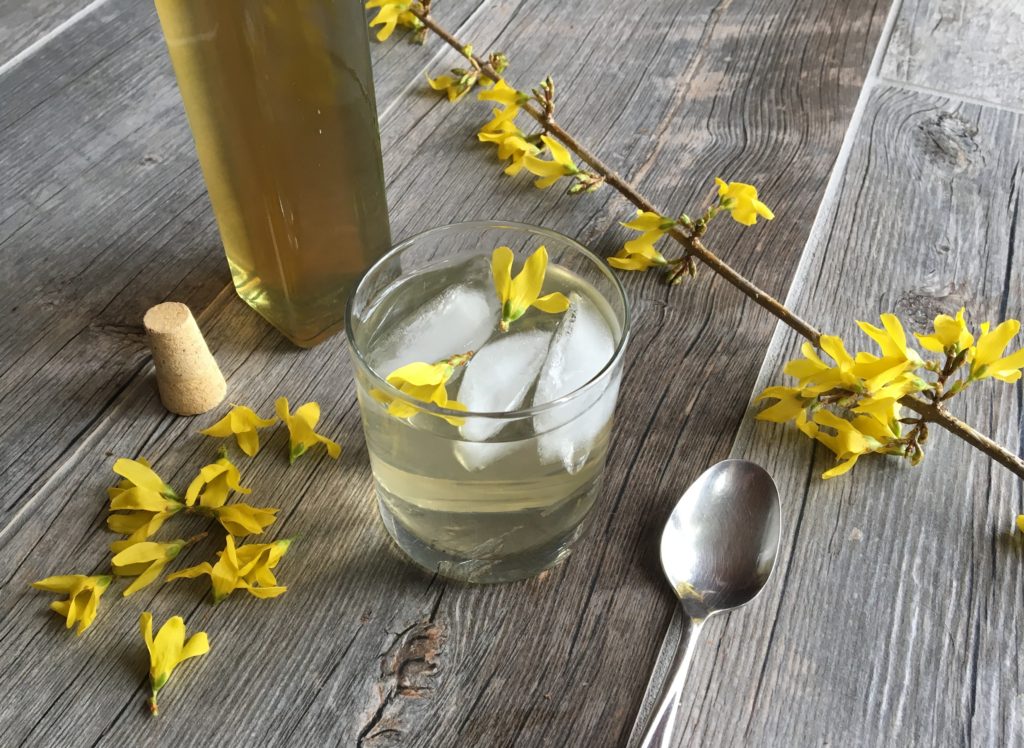
Forsythia is starting to bloom at high elevations and you can make a simple syrup out of this brief bloom (pictured above). Only about 5% of our forsythia has bloomed, but those flowers probably won’t survive today’s (04/27/19) snow and low temperatures (41F).
You can do so much with young Japanese Knotweed shoots and this is a great idea because they are an invasive species. Use young knotweed like rhubarb and put it in salads, stews, fruit pies.
Rob Handel at Heather Ridge Farm makes a nettle soup that I’m still marveling about years later. Catch the grey-green, toothed leaves of nettle before they flower. They reportedly contain an extensive variety of nutrients like Vitamins, A, B, C and K; minerals like calcium, magnesium and iron; amino acids; polyphenols and carotenoids. Nettle allegedly reduces inflammation and lowers blood pressure.
Here in the glorious Catskill Mountains, locals used to pick ginseng, wild leeks (ramps), chanterelles, and other rare delights in a sustainable fashion, but now we have visiting hikers ripping out all the ramps, bulb and all, to take home, or marketeers hauling out ramps by the truckload in garbage bags to sell downstate at markets. So now we must conserve – or transplant. Foraging is a great way to supplement your diet and reduce your carbon footprint. Sustainable foraging is essential, or our rare delights may disappear.
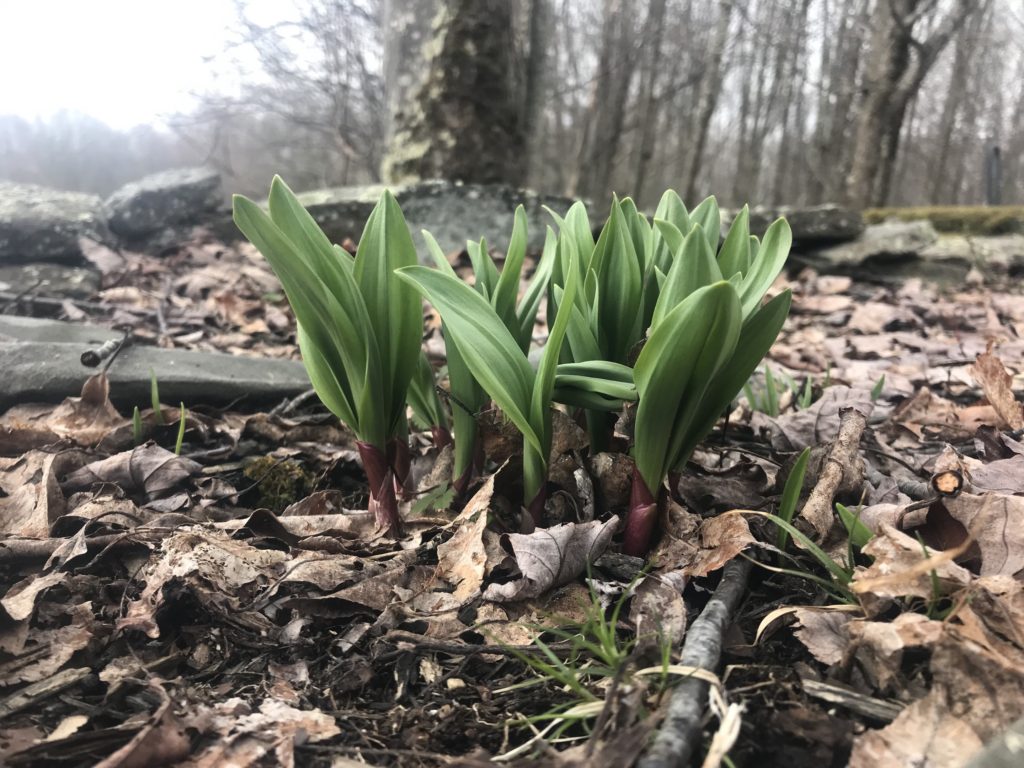
Here at Upstate Dispatch, we transplanted three wild ramps years ago that add a bunch to their number every year and they seem to love it where they are (pictured above). The secret is to plant them somewhere wet and shaded with plenty of tree cover, a place that sometimes gets boggy in rainy periods or where you find lots of mossy carpeting instead of grass.
Until recently, seasonal eating was once a relic of our agrarian past, like that quaint anachronism Sunday best. Sunday best is definitely as dead as the dodo in this consumer age and ramps will be gone too if we don’t harvest sustainably. Because of there rarity, they’re very popular and seasonal eating is making a big comeback in certain areas.
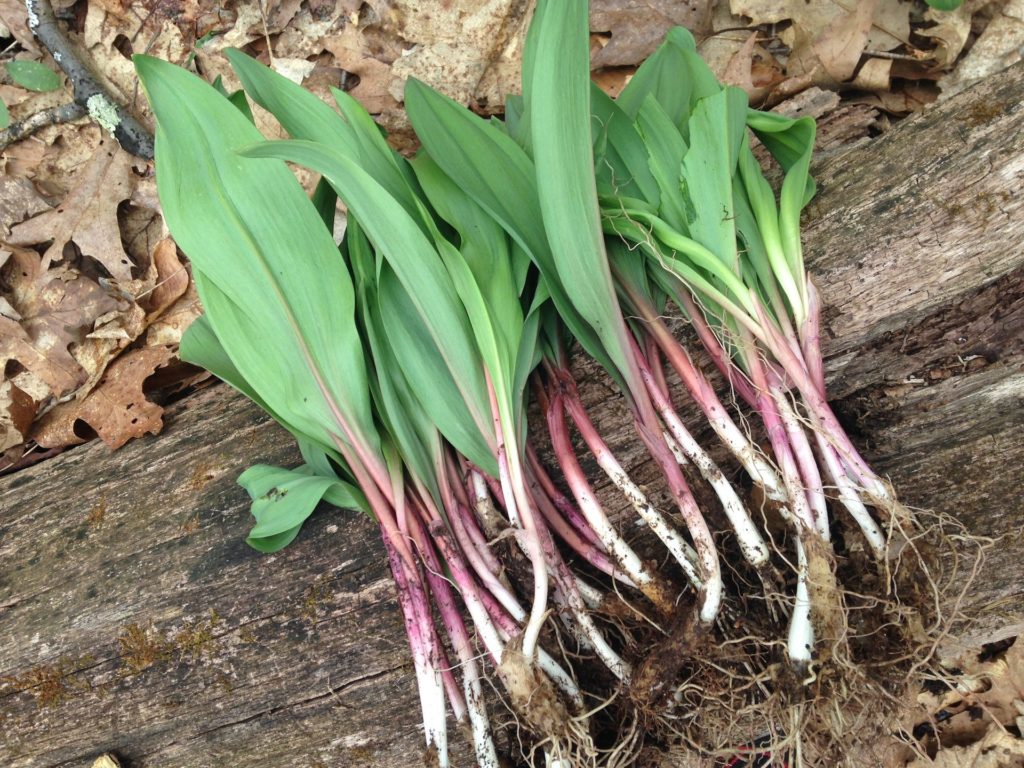
If you’re foraging on public land, only take some of what you find and only take the leaves by cutting above the bulb. Don’t remove the entire ramp.
Please do not pull ramps like this, pictured below, unless you’re picking on your own property.
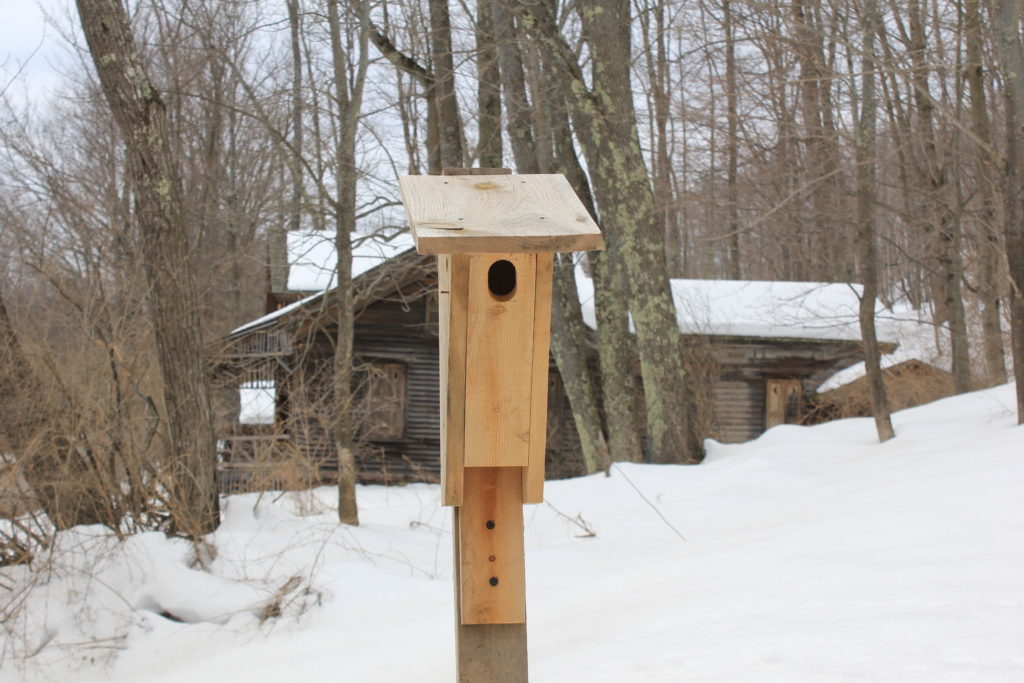
Former DEC ranger, Patti Rudge, of Oliveria, will show participants how to attract nesting bluebirds in specially constructed bluebird boxes. Participants will have the opportunity to purchase a nesting box to attract a nesting pair to their own property.
Celebrate Earth Day with the great naturalist and Catskill Mountain native, John Burroughs (1837-1921), John O’Birds, as he was known during his lifetime.
Allen Nichols of the American Chestnut Foundation will speak at the Catskill Center, this Saturday April 13th, 2019 at 1pm on the restoration of the beloved American Chestnut. The Catskill Center is at 43355 Route 28 Arkville, NY 12406. This event has been organized by John Burroughs Woodchuck Lodge.
According to the foundation: “More than a century ago, nearly 4 billion American chestnut trees were growing in the eastern U.S. They were among the largest, tallest, and fastest-growing trees. The wood was rot-resistant, straight-grained, and suitable for furniture, fencing, and building. The nuts fed billions of birds and animals. It was almost a perfect tree, that is, until a blight fungus killed it more than a century ago. The chestnut blight has been called the greatest ecological disaster to strike the world’s forests in all of history.”
The AC Foundation is committed to “restoring the American chestnut tree to our eastern woodlands to benefit our environment, our wildlife, and our society. Unlike other environmental organizations, TACF’s mission is not about preventing environmental loss or preserving what we already have. The concept of our mission is much bolder and more powerful. It’s about restoration of an entire ecosystem and making our world a much better place than we found it.”
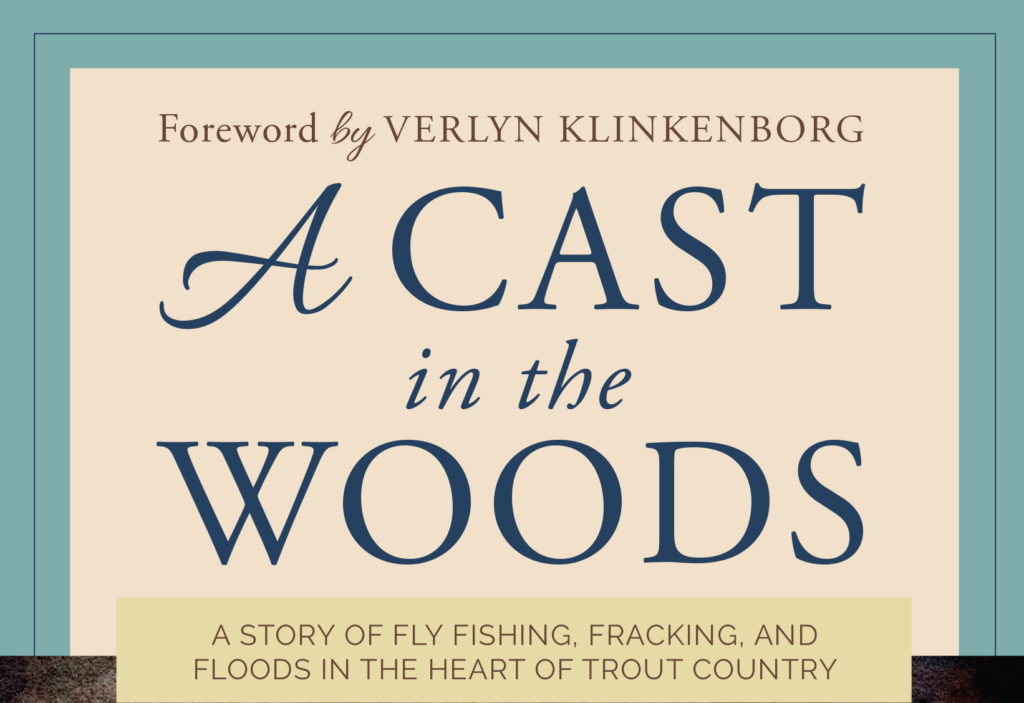
It’s a familiar story: writer buys home in the Catskills for [insert reason] and ends up losing heart, time and, no doubt a smidgeon of sanity to conservation, restoration and protection of these beloved mountains and its river network. For Stephen Sautner, the reason was a familiar one: fly fishing. An avid outdoorsman from boyhood, he decided to buy a fixer-upper cabin on the banks of a tributary and turn it into a “fish camp” for holidays and weekends until retirement. Well, that’s what he thought. Turns out Mother Nature had other plans for him and this portion of the river that ran through his 14-acre property, that he named simply “Six-Foot-Wide Stream”, but it was anything but simple. Several devastating floods, flora and fauna infestations and a scare over fracking gave him an all-consuming education he didn’t anticipate. But he would do it all over again, he says: “come spring, when the warblers have returned, and mayflies are hatching and brook trout are rising to them, and I’m siting on the front porch sipping coffee and watching it all, I believe I wouldn’t have changed a thing”.
Upstate Dispatch has been pretty quiet so far this month. It’s been like a reference library at HQ as we research future projects. There’s been a lot of reading going on and some fiction-writing.
As another superb ski season comes to a close, fly fishing season will be hard on its heels. April 1st is opening day across the Catskills. Esopus Creel is preparing to open a store next to Woodstock Brewery in Phoenicia. Stephen Sautner has published a new memoir about conservation, fly fishing and life in the Catskills titled A Cast in the Woods. I interviewed Stephen, a lifelong fisherman, for my radio show today, and will be posting a print interview with him online in the next few days. Trout Tales gears up for a couple of months of events, classes, and activities in rivers and streams flowing through these mountains.
While we work on content, specifically podcasts, we offer some interesting links to articles on the arts, food and the outdoors.
Are you ready from Spring migration? The National Audubon Society’s birding app.
It would have been Walt Whitman’s 200th birthday this year on May 31st, 2019. John Burroughs Woodchuck Lodge is hosting a celebration that begins at Union Grove Distillery in Arkville on the evening of May 31st, 2019. Check the website for details.
And finally, an example of how hoards of people descend on a natural wonder and ruin it, from the LA Times. Please adhere to Leave No Trace guidelines when enjoying nature: take only photographs and leave only footprints.
On March 15th last week, we woke to a bare Catskills landscape like it had thrown off its white quilt in the night and saw a high of 65F that day: such a stark difference from last year on the same day in the same place, where it remained at 37F and covered in snow.
Just before noon last week, we decided to check the last surviving bee hive. To our delight, after five years of trying to keep bees and failing, we discovered that our white hive of bees survived the winter. (The Warre hive into which we had installed a swarm last year did not.)
We re-stocked the surviving bee hive with food patties for the bees, just in case we got another cold snap, and put back the lid. Last year, we built a heavy “roof” for our hive and insulated it with old, woolen sweaters and pillows and this seems to have kept them warm. The hive is thriving.
Electric vehicle-charging stations are springing up all over the Catskills. Here’s a list within the Catskill Park Boundary and within the NYC watershed starting north at the Schoharie Reservoir on Route 30, and running south though the Catskills down to Roscoe on Route 17. Click on the links to Google Maps. Take a tour through the mountains in your electric vehicle, see the sights and charge up along the way. Also noted: nearby inns or restaurants. Cell service is intermittent in the Catskills, especially between Andes and Delhi, and between Big Indian and Phoenicia, so physical maps are still essential for this area.
Blenheim-Gilboa Power Project, 397 Power Plant Access Rd, Gilboa, NY 12076. A pretty remote part of the Catskills by the Schoharie Reservoir. Close by: Heather Ridge Farm, Restaurant & Store, open year-round.
Village of Hobart Public Parking, 11 Cornell Ave Hobart NY 13788. Nearby: Bull & Garland (closed until March 2019), The Sheep’s Nest. Hobart “Book Village”: a magical bibliophile’s paradise nestled in one of the most scenic areas of the Catskills.
Delaware County Electric Co-op, 39 Elm Street, Delhi, NY 13653. Nearby: Brushland Eating House, Catskills Regional Harvest Farm Store, Goldenrod, Tay Tea, Catskills Momo Tibetan Restaurant. Spotty cell service in surrounding areas. Know before you go.
Winwood Inn, 5220 NY-23, Windham, NY 12496. Nearby ski mountain and Windham Country Store, which does a fantastic Mean Green Burger using jalapeño mayonnaise.
Village of Margaretville Public Parking, 48 Walnut Street, Margaretville, NY 12455. Nearby: Picnic, Trattoria Locale, The Cheese Barrel, The Binnekill Tavern, all on Main Street. Cell service here. State Trooper station about a mile west of here on Route 28/30.
Emerson Resort & Spa, 5340 Route 28, Mt Tremper, NY 12457. Nearby: Phoenicia Diner Route 28 (try the everything), Peekamoose on Route 28, The Pines on Route 212. Cell service drops for a while in surrounding areas. Know before you go.
Woodstock Community Center, 56 Rock City Rd, Woodstock, NY 12498. Nearby: Garden Cafe, Upstate Films, The Tea Shop of Woodstock. a good wine store and all the delights of Woodstock further out into the village.
Bread Alone Bakery, 3962 NY-28, Boiceville, NY 12412. Bread Alone does a nice Hudson River Breakfast. Nearby: Boiceville Supermarket, the Goods Luncheonette, try the fish and chips.
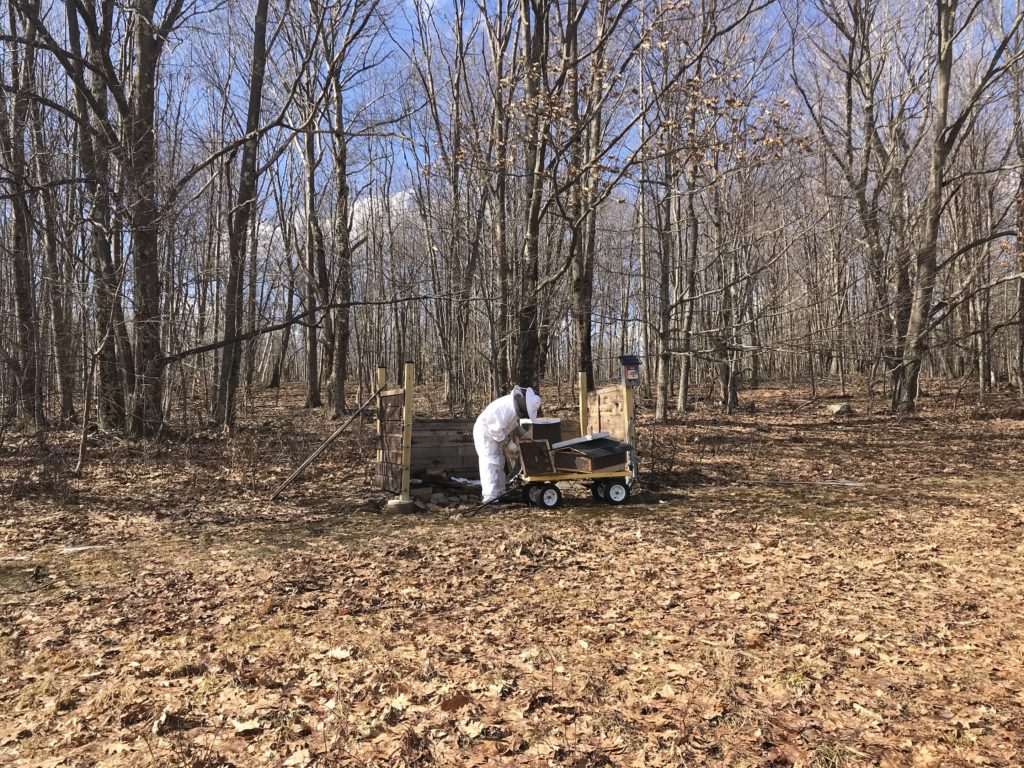
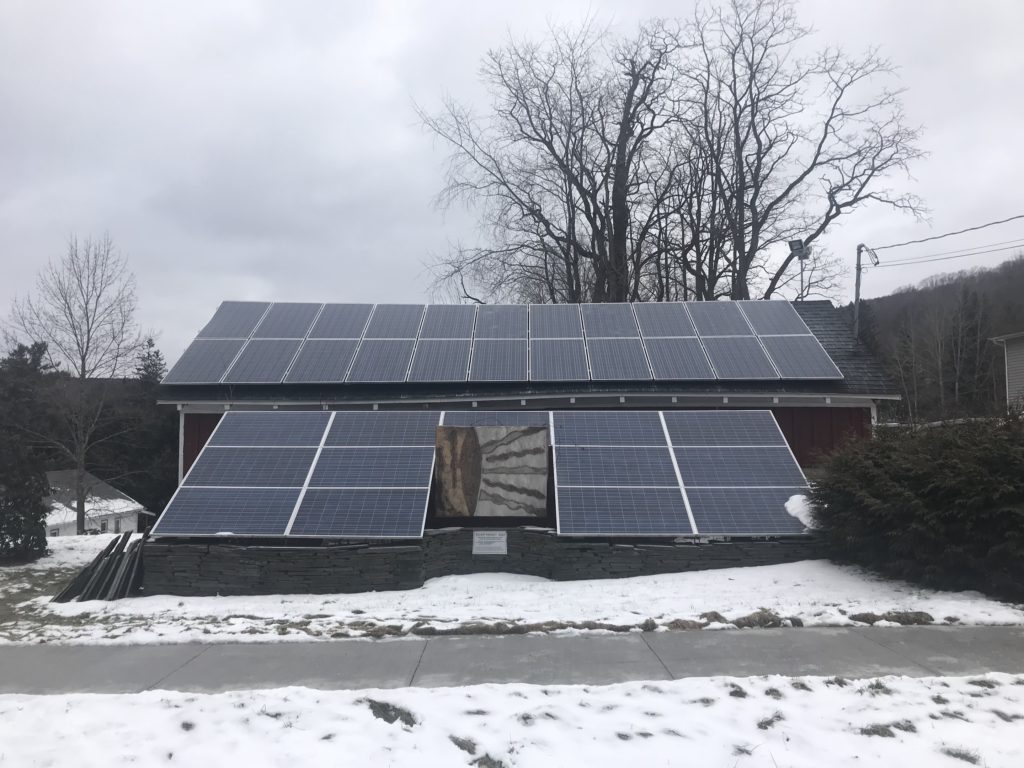
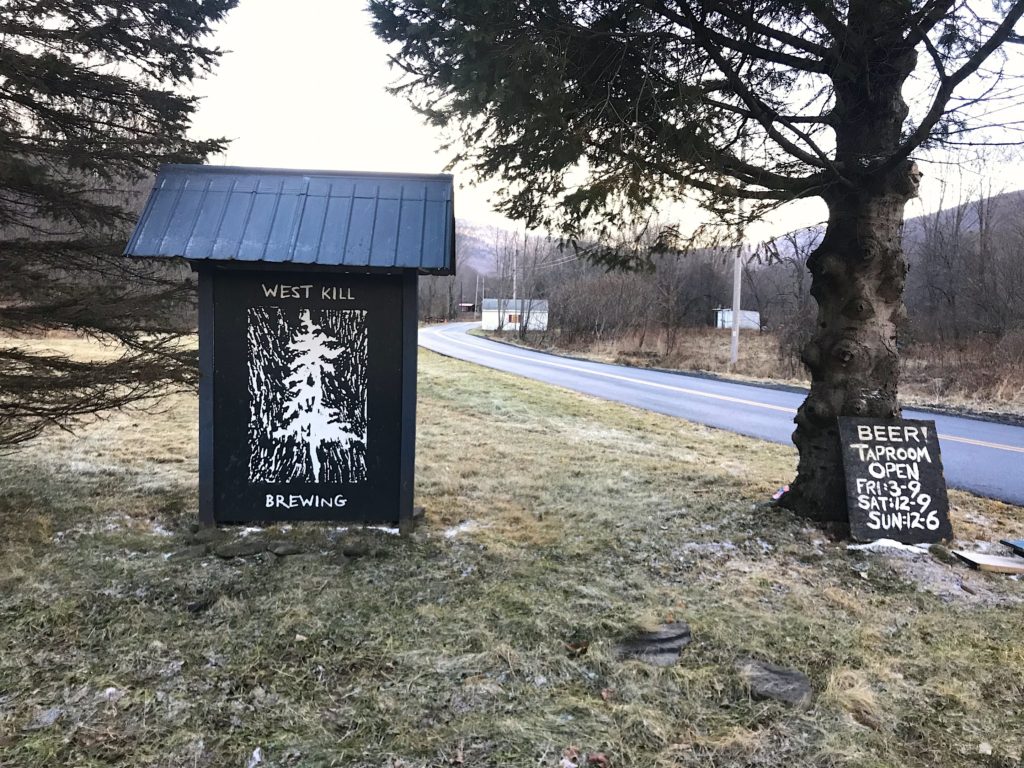
Nestled in the foothills of the Catskills’ Hunter-West Kill Mountain Wilderness, almost at the end of a dead-end road leading to some the region’s most popular trails, is West Kill Brewing, with its small tap room, that’s been open for about a year. The standout beer is the fruitiest IPA for miles around, Moon Farmer IPA, but most of the beers here have some sort of unique berry, fruit, herb, pine or citrus combination in them and some of them are brewed with honey from West Kill Brewing’s hives. There’s even a basil IPA and a Belgian made with spruce tips. The beers here are not your regular run-of-the-mill offerings, they are mindfully made. Much thought has clearly gone into the recipes that incorporate a variety of the local flora. Maybe it was the strenuous hike to Rusk Mountain that influenced my tastebuds, but I was so surprised when I took a first gulp of Moon Farmer that I went straight to the counter to order a four-pack to take out. I don’t even like IPA.